
Brand
Space Of Sound
Madrid, Spain
- Tech House
Biography of Space Of Sound
The Genesis of a Myth: 1993 and the Sunday Revolution
The history of electronic music in Spain has a chapter reserved exclusively for Space of Sound. Founded in 1993, this brand was not born simply as just another party, but as a cultural and sociological response to the need for the evolution of nightlife in Madrid. In a context where the famous "Ruta del Bakalao" was beginning its media decline and the capital was looking for its own identity, Space burst onto the scene with a radical proposal: the morning session.
Strategically located at the Estación de Chamartín, Space of Sound transformed the concept of time. What was initially conceived as an after-hour for the tireless, quickly mutated into an event with its own entity. Sunday mornings ceased to be the end of the weekend to become the peak moment of the week. The brand established a new liturgy: waking up early (or not sleeping at all) to go dancing, creating a loyal community that made a weekly pilgrimage to the north of Madrid.
The Temple of Acoustics: Sala Macumba
The brand's success was inseparable from its physical home: the legendary Sala Macumba. Considered for years as one of the best clubs in Europe, Macumba offered an open-plan architecture and a massive capacity that allowed for total communion among the public. But its true secret lay in its sound system.
Space of Sound was characterized by a technical obsession: offering impeccable audio quality. The power of its bass and the clarity of its highs defined the standard of what a clubbing experience should be. Added to this was a deployment of cutting-edge lighting and lasers, and the presence of its iconic go-go dancers and performances, which provided a touch of theatricality and visual fantasy never seen before in the sobriety of the Madrid night.
The "Space Sound": House, Tribal and Legendary Residents
Although the world's most acclaimed international DJs passed through its booth (from Carl Cox to Deep Dish or Tiësto), the true identity of Space of Sound was forged by its residents. Names like Ismael Rivas, Oscar de Rivera, Javier González or José de Divina were not mere selectors, but architects of a unique atmosphere.
Together they defined the so-called "Space Sound": an evolution of House and Progressive with Tribal tints, characterized by hypnotic percussion, punchy grooves and inexhaustible energy designed to keep the dance floor up during marathon sessions. The music at Space was not commercial, but it was accessible; it was sophisticated, but visceral. This musical formula educated the ears of several generations of Madrilenians and positioned the brand as a benchmark of musical quality globally.
A Space of Freedom, Tolerance and Avant-Garde
Beyond the beats, Space of Sound stood as a bastion of social freedom. In an era where many barriers still existed, the Macumba dance floor became a melting pot of diversity. It was one of the first major clubs where the LGTBIQ+ community and the heterosexual public coexisted with total naturalness, united only by the music.
The brand fostered a free aesthetic, where the public felt comfortable expressing themselves through their clothing and attitude. This atmosphere of respect and hedonism attracted celebrities, artists and international clubbing tourism that traveled to Madrid with the sole purpose of living the "Space experience". For nearly two decades, it was the economic and cultural engine of the northern part of the capital.
The End of an Era and the Silence (2011)
In May 2011, the news shook the scene: Space of Sound closed its doors due to administrative and licensing problems related to the Chamartín venue. The closure was not just the end of a business, but the trauma of an entire generation of clubbers.
For more than a decade, the brand remained in a "mythical limbo". Occasional events were held (such as New Year's festivals or Day One), but the weekly residency disappeared. However, the memory of its sessions kept the flame alive, turning the brand's merchandising (its fans, t-shirts and logos) into objects of cult and nostalgia.
The Rebirth: 2022 and the New Era at LAB theClub
When many thought that Space of Sound would remain only in history books, in 2022 the miracle happened: the return home. The brand returned to its original location at the Estación de Chamartín, now renovated under the name LAB theClub.
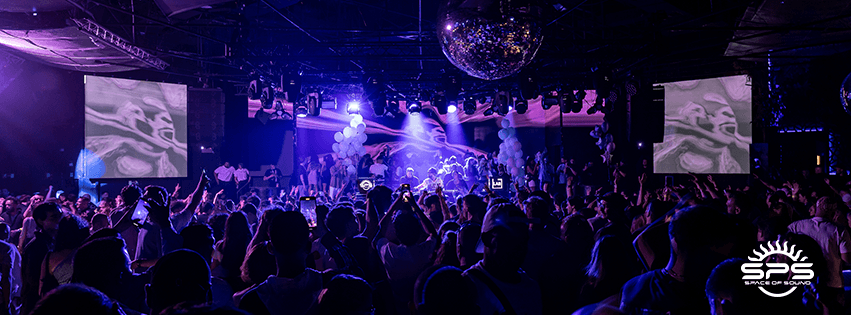
This return was not an exercise in "retro" nostalgia, but a reinvention adapted to the 21st century. The new Space of Sound combines its musical heritage of high-quality Tech-House with a brutal technological commitment, incorporating immersive LED screens and total digitalization. In addition, it has adopted an Eco-Friendly philosophy, caring about the sustainability of its events. Today, Space of Sound has achieved the impossible: recovering its veteran audience and making the Generation Z fall in love, proving that, 30 years later, it remains the undisputed owner of Sundays in Madrid.
Brands related to Space Of Sound

Space Of Sound in the Magazine

TV· 26 Dec 2024
Ismael Rivas: Space of Sound and the Evolution of the DJ in Spain

TV· 25 Nov 2024
The Evolution of Electronic Music in Madrid with Oscar de Rivera

TV· 21 Mar 2024
Management and Booking at LAB theCLUB with Juan Bisquert
TV· 26 Dec 2024
Ismael Rivas: Space of Sound and the Evolution of the DJ in Spain
TV· 25 Nov 2024
The Evolution of Electronic Music in Madrid with Oscar de Rivera
TV· 21 Mar 2024
Management and Booking at LAB theCLUB with Juan Bisquert

TV· 13 Mar 2024
Ivan Pica: 30 Years of History in the National House Scene