Venue
Ciudad de las Artes y las Ciencias
Valencia, Spain
Biography of Ciudad de las Artes y las Ciencias
The night the Turia opened an eye
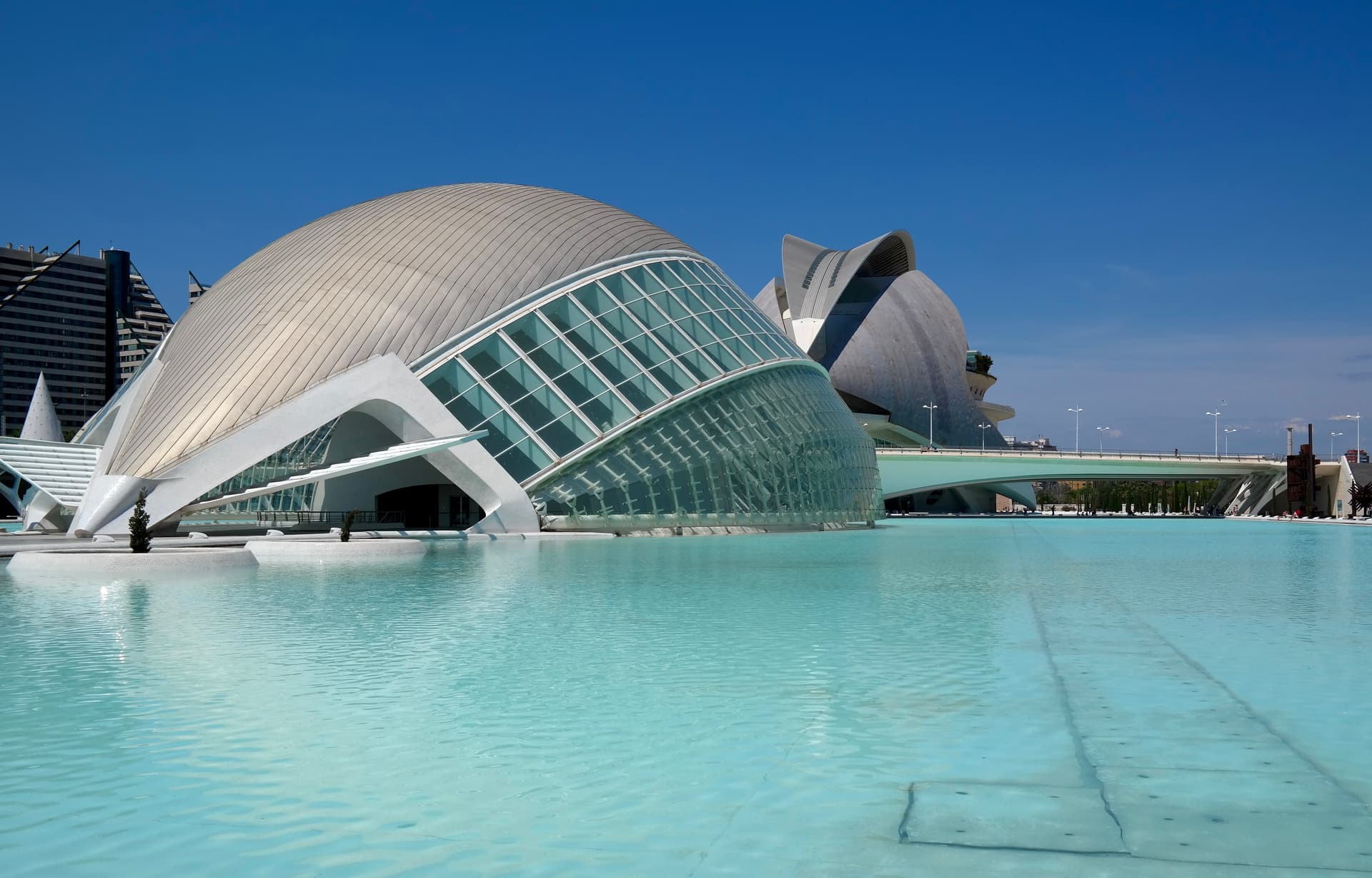
On April 16, 1998, the Hemisfèric by Santiago Calatrava lit up the old Turia riverbed with fireworks, digital imagery, and a concert by Michael Nyman. It was not a nightclub: it was the first building of the City of Arts and Sciences, a concrete eye whose pupil is a projection room and whose eyelids are completed when reflected in the ponds. Since that night, Valencia gained a venue designed to be looked at, walked through, and listened to.
Six pieces on the dry riverbed
The project, relaunched in 1996 by adding arts to science, unfolds for almost two kilometers. Next to the Hemisfèric are the Umbracle, a Mediterranean viewpoint and parking lot; the Museu de les Ciències Príncipe Felipe, an interactive museum of about 40,000 m²; the Oceanogràfic by Félix Candela, the largest aquarium in Europe, opened in 2003; the Palau de les Arts Reina Sofía, an opera house inaugurated on October 8, 2005; and the Àgora, a covered plaza from 2009 converted in 2022 into CaixaForum València. In 2007, the complex was among the 12 Treasures of Spain. The complex receives nearly 3.5 million visits per year.
Dome, opera, and festivals
Music here does not live on a single dance floor. The Hemisfèric—concave screen of 900 m², IMAX Dome, FullDome, and ATMOS surround sound—has programmed musical planetariums like Pink Floyd: The Dark Side of the Moon. The Palau concentrates lyrical and symphonic music in several halls, with names like Lorin Maazel, Zubin Mehta, or Plácido Domingo. Outside, the Festival de les Arts turns the venue into a stage for pop, indie, and electronic music every June. In 2026, the municipal noise ordinance canceled the second day: this is not a clubbing industrial estate, it is a monumental neighborhood where volume clashes with the city.
A set that remains open
The same landscape has been a set for Tomorrowland and Andor. It remains open almost every day, with different schedules by building and season. It is not an electronic club: it is the great Valencian artifact where opera, immersive cinema, and outdoor concerts are projected over the water.