
Venue
Cidade da Cultura de Galicia
Santiago de Compostela, A Coruña, Spain
Biography of Cidade da Cultura de Galicia
The peak that Eisenman folded over Compostela
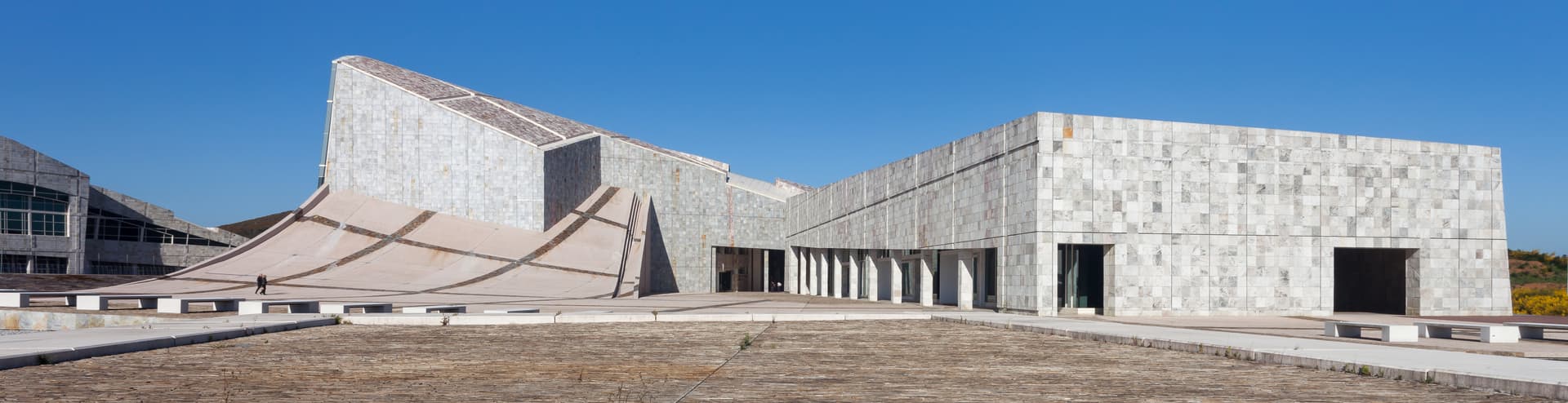
Peter Eisenman did not implant a building on a hillside: he folded Mount Gaiás until it became an artificial peak of stone, glass, and grids. After winning the international competition held by the Xunta in 1999, the New York Five architect superimposed the layout of the historic center and pilgrimage routes onto the mountain, with the scallop shell as the background figure. On January 11, 2011, the Library and Archive of Galicia were inaugurated; the following day, the complex opened to the public. The complex, covering about 142,000 m², is traversed like a city: streets, arcades, and a central plaza that articulates the volumes.
The theater that didn't arrive and the plaza that did
The original project included six pieces. Those that remained in use were the Museo Centro Gaiás —a glass facade of almost 43 meters, more than 16,000 m² of surface area and 6,600 m² of exhibition space, opened to the public in June 2012—, the Creative Entrepreneurship Center, the CINC, and the Library-Archive. The Center for Music and Performing Arts and the International Art Center were halted. In 2021, the Edificio Fontán, by Andrés Perea, was built on the structure of the unfinished theater, featuring an auditorium with up to 750 seats. The Hejduk Towers, by John Hejduk, serve as an exhibition space. The Bosque de Galicia, the Theater Garden, and other parks turn the Gaiás into an open-air cultural venue, with a restaurant, terraces, and several parking lots.
From Björk to techno on stone
The Gaiás is not a nightclub, but its plaza has functioned as a large-format venue. On June 22, 2012, Björk presented «Biophilia» outdoors before about 5,000 spectators and inaugurated the complex as a stage for major concerts. Since that same year, Atardecer no Gaiás has programmed music in the summer. The Museo Centro Gaiás was the professional host of WOMEX in 2014 and 2016. In 2025 and 2026, the plaza hosted Wake Up, techno and house marathons with two stages, occasionally turning that stone esplanade into a dance floor until dawn.
A daytime venue that lights up by programming
The complex is open every day from 08:00 to 23:00; the museum exhibitions, from Tuesday to Sunday. There is no resident club or fixed electronic DJ booth: it is a cultural macro-complex of the Xunta that, when the agenda calls for it, operates as a venue for concerts and an open-air dance floor. More than 11 million visits since 2011 mark its scale. Those arriving on lines 9 or C11 end up at the Gaiás bus bay, just a few minutes from the plaza that Eisenman imagined as the heart of this city of culture.