
The redesign of the Buchla Ziggy and its new roadmap
Recently, the American manufacturer Buchla has issued an official statement through its corporate channels and its crowdfunding platform to update the production status of its upcoming hardware release. The highly anticipated Buchla Ziggy synthesizer, a compact desktop-format analog instrument, has officially confirmed its shipping window for the month of December 2026. Originally projected for the autumn of this year, the company has decided to slightly postpone distribution to implement a series of structural and sonic improvements based on direct feedback from the community.
The public's first hands-on experience with the prototype took place last May during the Superbooth event in Berlin. Although the response from attendees was extremely positive regarding the equipment's capabilities, the engineering team chose to take advantage of the summer months to perfect the circuitry. This strategic decision seeks to optimize the signal-to-noise ratio, ensure greater reliability in the global supply chain, and raise the chassis build quality to meet the demands of professional use in the music industry.
West Coast architecture without cables: a modernized approach
True to Don Buchla's legacy, the sonic core of the Ziggy gravitates around the legendary complex oscillator. This architecture moves away from traditional subtractive paradigms to embrace West Coast synthesis, based on the analog generation of harmonics through amplitude modulation (AM), frequency modulation (FM), and wavefolding. The signal is subsequently sculpted through a low-pass gate (LPG), a hybrid component between a filter and an amplifier that gives sequences that characteristic percussive and organic behavior.
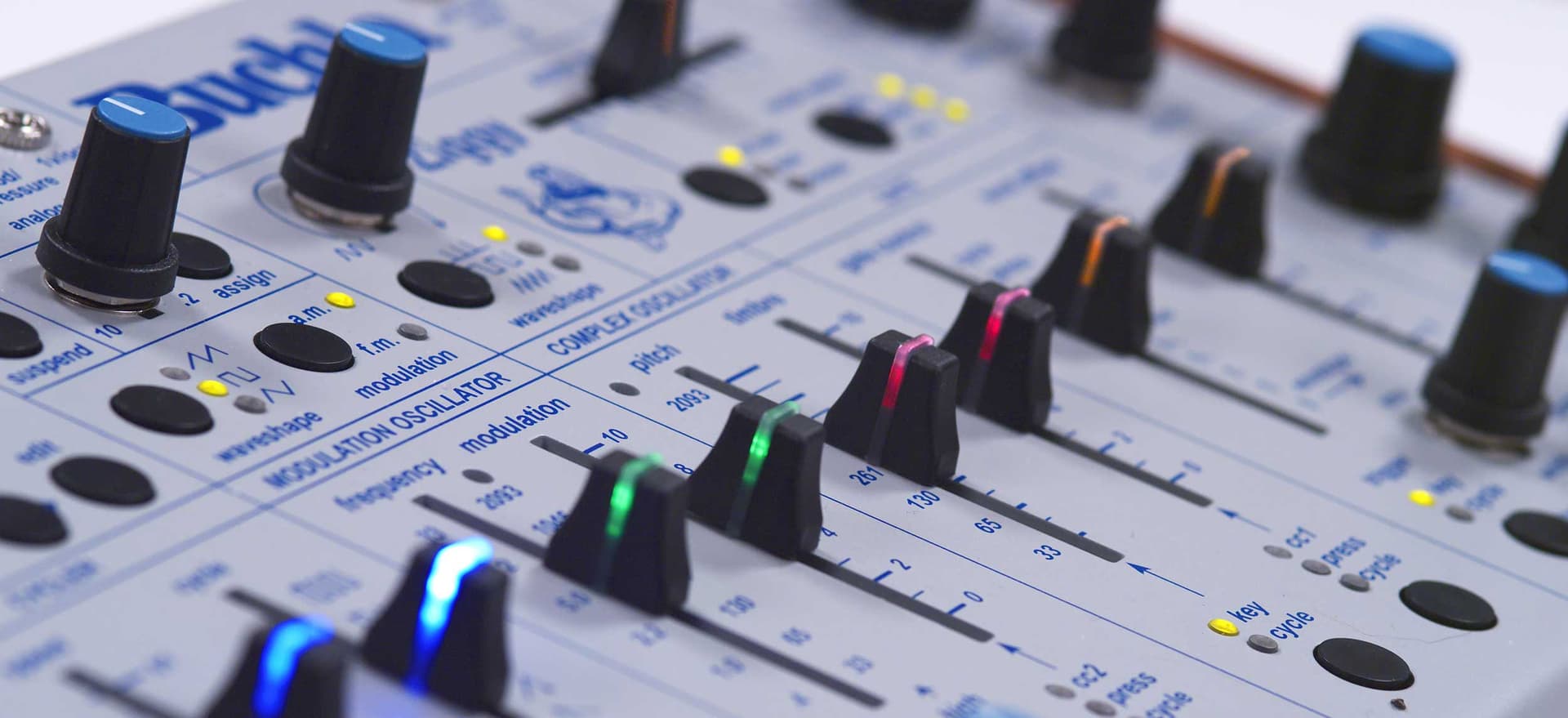
The most groundbreaking aspect of the Buchla Ziggy is its unpatched design philosophy. Unlike bulky and traditional modular systems, this equipment completely dispenses with cumbersome physical cables. Instead, the routing of modulation signals is managed immediately through dedicated switches, sliders, and rotary encoders. This allows for a much faster workflow focused on gestural performance, consolidating it as an extremely agile live act instrument rather than a static studio laboratory.
In addition to the pure synthesis block, the Ziggy incorporates a high-resolution digital effects unit. This final section of the audio chain allows for the application of spatial reverbs, rhythmic delays, and distortion algorithms that push the limits of the complex oscillator, providing the producer with a completely autonomous sonic canvas.
Technical optimizations implemented during the summer
The additional weeks of research and development prior to its imminent shipment at the end of 2026 have allowed Buchla's engineers to integrate highly demanded features into the contemporary electronic production ecosystem.
- Unified connectivity: It has been possible to consolidate digital audio transmission, MIDI data, and power supply through a single USB-C port, drastically simplifying the studio setup.
- Expanded modulation: A second low-frequency oscillator (LFO) has been incorporated to increase routing possibilities, adding to the main modulation source called 'Cycler', which operates simultaneously as a clock, envelope generator, and random source.
- Advanced digital management: The equipment now has expanded internal memory capable of storing hundreds of presets. In addition, a web browser-based editor has been developed that functions as a library and creative control panel.
- Improved ergonomics: The final hardware will feature custom mechanical components, including buttons and potentiometers with tactile response optimized for real-time manipulation.
Impact on the desktop hardware ecosystem
With a market price set at the 999-dollar threshold, the Buchla Ziggy represents a historic turning point for the Californian manufacturer. Traditionally, accessing Buchla's exclusive sonic palette required an investment of thousands of dollars and a steep learning curve in large-scale formats. This new desktop module democratizes access to complex timbral textures without sacrificing an ounce of the analog rigor that defines the brand.
The convergence between the purity of analog voltage and the convenience of digital control is an unavoidable standard in the current landscape. The ability to save complex configurations with the press of a single button, while keeping the analog audio path intact, responds directly to the demands of clubbing and live set performances, where reliability is critical. Techno and experimental rhythm producers will find in this device an inexhaustible source of polyrhythmic sequences and metallic timbres, fundamental elements for sculpting the groove on dance floors.
Its integration capacity is total, allowing for native pairing with portable keyboards like the Buchla LEM218, as well as impeccable synchronization with any modern Digital Audio Workstation (DAW) thanks to its MIDI support and external voltage control (1v/octave CV). With the first batches yet to reach the shelves of specialized distributors at the end of this year, the Ziggy is shaping up to be one of the most disruptive sound design tools of the season.