
Algorithmic chaos as a creative engine in Ableton Live
The prolific producer, sound designer, and multidisciplinary artist Oliver Torr has shaken the music production ecosystem with the presentation of a new series of disruptive tools designed specifically for the Ableton Live environment. Through Glazmo Network, the cutting-edge community and conceptual platform founded by Torr himself, two devices focused on rhythmic deconstruction and extreme audio manipulation have been released to the market. These software developments are framed within an exhaustive empirical research that the artist calls "sonic mythologies," a creative universe where unpredictability, digital error, and glitch aesthetics take the leading role over conventional electronic production.
With a base of operations historically divided between Prague and Athens, Torr has established himself in the European circuit for his hyper-technical approach, combining modular synthesis, hardware design (with ties to collectives like Bastl Instruments and Noise.Kitchen), and custom software programming. The recent release of these devices represents a direct extension of his artistic philosophy, aimed at producers and sound designers who seek to escape the rigidity of the traditional quantization 'grid' to enter territories of algorithmic uncertainty.
Agitate and the algorithmic collection of metadata on YouTube
The core of this technological update, developed under the Max for Live visual programming environment, is divided into two main tools that challenge the logic of standard software. The first of these, christened as Agitate, is a device designed to alter and deform the master tempo of Ableton Live in an elastic and chaotic way. Unlike linear BPM automations or conventional tempo curves, Agitate introduces complex mathematical fluctuations that can subtly humanize a sequence or completely destroy a track's groove, allowing for extreme rhythmic transitions that defy standard clubbing metrics.
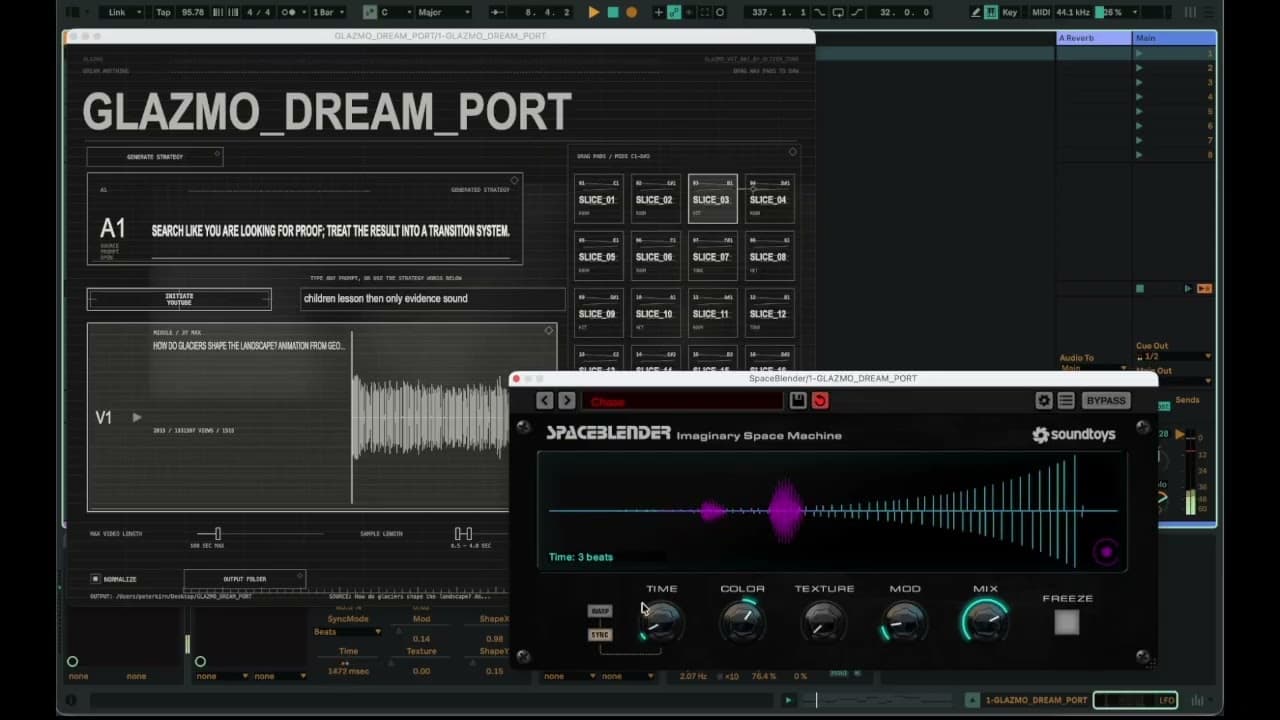
The second tool proposes a radical approach to percussive synthesis and the art of sampling. The software allows users to assemble complete drum kits by extracting audio fragments from what the author describes as "the chaos of YouTube surfed by artificial intelligence." Through automated tracking algorithms, the device collects sonic residues, corrupted metadata, and compression artifacts hosted on the video platform. This process transforms 'slop' (digital sludge or internet junk content) into punchy percussion, industrial textures, and sharp transients, making it ideal for niche genres like IDM, experimental techno, and deconstructed ambient.
The Glazmo Network universe operates as an alternative reality where sound is the currency and traditional recording is prohibited, fostering the use of interdimensional feedback systems.
— Official Glazmo Network Manifesto
This release coincides with a period of high studio activity for the Czech artist, who has recently collaborated closely with the acclaimed duo MIRA新伝統 (Mira Shin Dentou), exploring new frontiers in electroacoustic composition. The tools developed by Torr do not function merely as signal processors, but as generators of happy accidents, forcing the user to react in real-time to completely unpredictable sonic stimuli.
Digital imperfection as a standard in sound design
The introduction of Agitate and the percussion generator based on YouTube data mining evidences an unavoidable paradigm shift in contemporary music technology. While much of the commercial software industry obsessively pursues high fidelity, oversampling, and pristine analog emulation, the underground scene and independent developers are firmly committed to intentional signal degradation. The use of artificial intelligence processes not to restore or clean audio, but to find, isolate, and amplify noise, underscores a growing demand for rougher, distorted, and organic textures.
For producers of advanced electronic music, the ability to manipulate the global tempo of a project with the violence and fluidity that Oliver Torr proposes opens the door to non-linear track structures, moving away from static, immovable 120 or 130 BPM. In an industrial context where the massive saturation of record releases demands extreme levels of originality, the integration of controlled chaos and algorithmic randomness is emerging not as a simple aesthetic resource, but as a fundamental technical necessity to expand the limits of future sound design.