
The Resurrection of an Analog Myth in Pocket Format
The music technology industry has recently witnessed the official confirmation of one of the most anticipated projects from the German manufacturer Behringer. After a long development period and multiple prototypes evaluated since its initial announcement, the company has launched the AKS MINI to the market. This device is presented as an ultra-compact polyphonic analog synthesizer that seeks to democratize access to historical sound textures, offering a gateway to experimental synthesis for a groundbreaking price of 99 dollars in the US market, and an approximate value of 119 euros for pre-orders in European territory.
The design and sound engine of the AKS MINI pay direct homage to the legendary 1971 EMS Synthi AKS. Originally dubbed the "suitcase synthesizer," the original British instrument became a fundamental piece for the evolution of electronic music and progressive rock. Its unmistakable sonic character was the backbone of masterpieces like the album The Dark Side of the Moon by the band Pink Floyd, and it stood as the preferred tool for producer Brian Eno to forge his ambient landscapes and avant-garde explorations. Today, Behringer condenses that legacy into a module that fits in the palm of your hand, eliminating the economic barriers that traditionally kept new creators away from classic analog hardware.
Sound Architecture and Technical Specifications
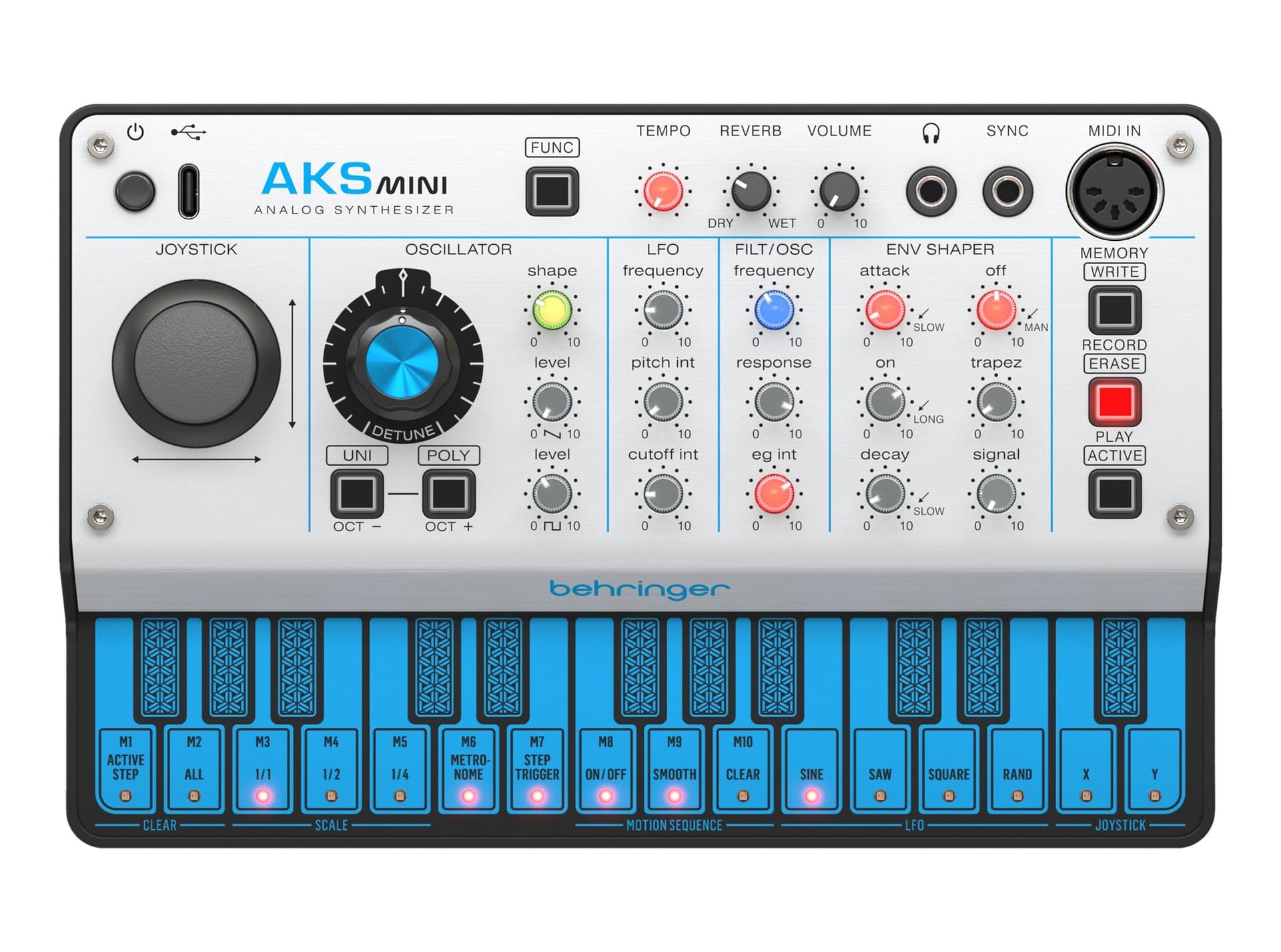
Far from being a simple desktop toy, the AKS MINI houses under its chassis a robust architecture that respects the purely analog signal path of its predecessor, while introducing conveniences typical of modern workflows. The heart of this instrument is based on a meticulous reproduction of the original circuitry from the seventies, ensuring that the electrical behavior of its components emulates the warmth and controlled instability that defined vintage hardware.
- Three independent voltage-controlled oscillators (VCOs), equipped with sawtooth and variable-width square waveforms.
- An analog low-pass filter (VCF) with resonance control, strictly modeled after the classic EMS design.
- A 27-key capacitive touch keyboard, designed to facilitate melodic performance in a small space.
- A two-axis joystick, an iconic element of the original model, assignable to any pair of parameters to execute organic modulations in real time.
- A 16-step motion sequencer with 10 memory slots, capable of recording automations and generating evolving sequences.
To complement the analog signal, the engineers have integrated a digital emulation of spring reverb that provides spatial depth without compromising the size of the front panel. Furthermore, the equipment overcomes the limitations of the seventies by incorporating polyphonic and unison playback modes, allowing everything from the execution of complex chords to massive bass lines. Regarding connectivity, the device is powered via a USB-C port and features full MIDI implementation, including support for NRPN and CC messages, as well as analog sync connectors to integrate seamlessly with modular drum machines and digital production environments.
The AKS MINI distills the legacy of the legendary suitcase synthesizer into a portable format, preserving the end-to-end analog signal path while adding polyphony and programmable patches.
— Behringer
The Paradigm of Accessibility in the Modern Studio
The arrival of this hardware underscores an inescapable trend in the electronic production ecosystem: the transition toward a model where studio-grade gear is no longer an exclusive luxury. By setting the price below the one-hundred-dollar barrier, the brand not only challenges its direct competitors but also redefines consumer expectations regarding what an affordable-format synthesizer can offer. The inclusion of advanced MIDI control and polyphony transforms a design over fifty years old into a fully functional tool for current sequencing standards.
For artists oriented toward techno, ambient, or experimental sound design, having a synthesis engine capable of generating unpredictable modulations and noisy textures is an invaluable resource. The joystick and motion sequencer invite tactile improvisation, moving the producer away from the computer screen and fostering a more instinctive approach during live performances. In short, this compact reissue not only preserves a crucial fragment of electronic music history but also updates it, ensuring that the unmistakable timbre that defined an entire generation of pioneers continues to resonate in the clubs and studios of the present.