
The Birth of a Misunderstood Machine
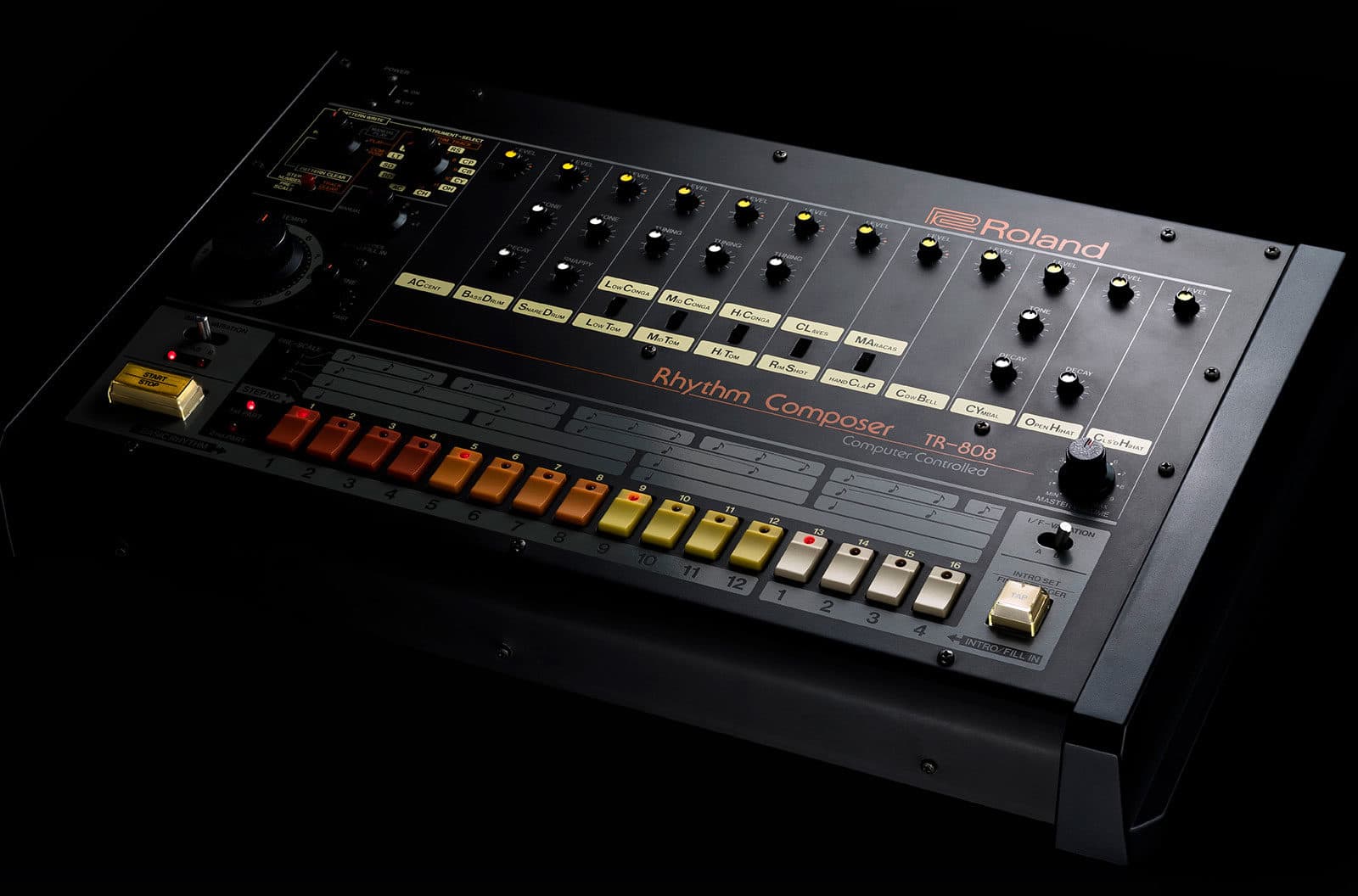
Recently, the global music community celebrated a new edition of 808 Day, paying tribute to the legendary Roland TR-808 Rhythm Composer. Introduced in 1980 under the vision of Roland founder Ikutaro Kakehashi and engineer Tadao Kikumoto, this drum machine was born in Osaka with a clear purpose: to offer an accessible alternative so musicians could create rhythmic foundations without needing to hire a session drummer. However, its initial foray into the market was far from triumphant. With a launch price of 1,195 dollars, the TR-808 used subtractive analog synthesis to emulate percussion, which resulted in sounds that the professional industry of the time considered artificial and unrealistic.
Facing high-end competitors like the Linn LM-1, which used expensive digital samples of real drums and cost around 5,000 dollars, Roland's proposal was systematically ignored by major studios. The kick drum did not sound like a traditional kick, the snare lacked the expected acoustic impact, and the cowbell did not resemble its real counterpart at all. Furthermore, the machine's sound architecture depended on specific and inexpensive transistors, such as the 2SC828-R, which exhibited unpredictable thermal behaviors. When these components, which paradoxically gave it its unique texture, became impossible to obtain in the semiconductor market, Roland made the irrevocable decision to discontinue the TR-808 in 1983. After having sold barely 12,000 units worldwide, the hardware was labeled at the time as a resounding commercial failure.
The Rebirth in the Underground Ecosystem
The interruption of its production marked, unexpectedly, the true beginning of its historical legacy. Unsold units and second-hand equipment flooded pawn shops in the United States, where its price plummeted drastically to around 100 dollars. This severe devaluation democratized access to programmable sequencing, putting the TR-808 directly into the hands of a new generation of independent producers in key cities like Detroit, Chicago, and New York. These visionary artists and clubbing pioneers were not looking for acoustic realism; they were looking for a sound that represented the future of electronic music.
The supposed weakness of the TR-808 quickly became its greatest virtue. The kick drum, generated from a decaying sine wave through a band-pass filter, provided bass frequencies so deep that they physically vibrated the sound systems of underground clubs, dictating the BPM of an entire generation. Fundamental figures like Juan Atkins and Carl Craig in the nascent Detroit techno scene, or Egyptian Lover in electro and Miami bass, adopted the machine as the core of their productions, released on independent labels that would change history. Likewise, the masterful use of the TR-808 by Afrika Bambaataa on the iconic track 'Planet Rock' (1982) demonstrated the immense potential of these synthetic rhythms to dominate the charts and dance floors alike.
Analog Anatomy and Contemporary Celebrations
The influence of the TR-808 transcends the decades and continues to shape the production paradigm in the present year. Its 16-step sequencer, known technically as TR-REC, established a standard for visual and intuitive programming that remains in effect in the vast majority of contemporary music production hardware and software. This August 2026, Roland has commemorated the machine's continuous impact by collaborating with global platforms to broadcast documentary series that trace the evolution of this hardware from its origins in Japan to its absolute dominance in hip-hop, trap, and modern house.
- The 'Kick': An expansive sub-bass wave that defined the techno groove and is the backbone of current sound design.
- The 'Snare' and 'Clap': Frequencies rich in white noise derived from defective transistors that cut through the mix with pinpoint precision.
- The 'Cowbell': An unmistakable synthetic metallic tone that has become an absolute hallmark of club culture.
Institutional Transcendence of the Hardware
More than four decades after its creation, the Roland TR-808 stands as an undeniable cultural institution within the music industry. What began as a technological limitation and an apparent commercial stumble transformed into a universal language for rhythm creators of multiple generations. Modern electronic music, in all its vast diversity of subgenres, could not be understood without the robust sonic foundations of this drum machine. The trajectory of the TR-808 demonstrates empirically that the deepest innovation often arises from imperfections and the unconventional use of technology, forever redefining the symbiosis between human and machine.
The TR-808 not only marked Roland's leap into the 1980s; it completely redefined what a drum machine could be.
— Roland Corporation