
The engineering behind Razornator: synthesis and acoustic emulation
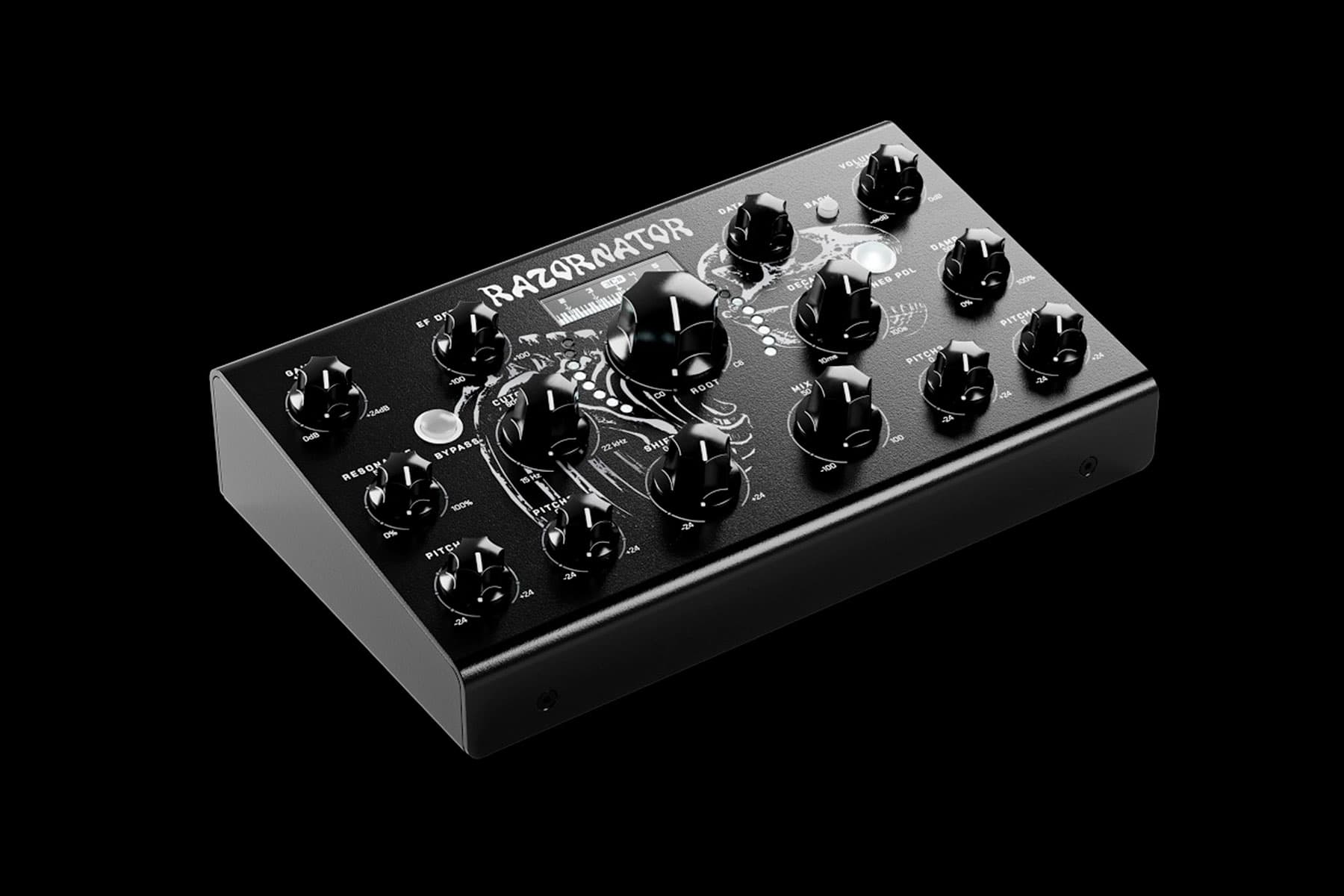
Recently, the renowned Latvian firm Erica Synths announced the market release of Razornator, a desktop stereo resonator conceived in close collaboration with the Dutch software development company 112dB. This new hardware joins the brand's catalog of compact effects units, offering an architecture focused on extreme harmonic alteration and acoustic emulation. The official presentation, held at the end of June 2026, marks a new milestone in the company's line of standalone processors, designed specifically to integrate into music production setups without the need for a Eurorack modular system.
According to the technical data published by the manufacturer, the operating core of Razornator is based on five chromatically tuned resonant delay lines. This algorithmic peculiarity, developed by the engineers at 112dB, allows the device to precisely emulate the resonance of real physical objects, such as acoustic instrument bodies, rooms, or complex architectural structures. By having chromatic tuning, the delay lines can be aligned in intervals similar to chords, giving the processing an eminently musical character. This feature is ideal for texturing synthesizers, bass lines, or drum machines in any studio setup, adding unusual depth to the most experimental genres of electronic music.
Signal flow: from analog overdrive to stereo compression
The internal routing of the unit reflects a meticulous approach to advanced sound design. Unlike a simple delay effect, the signal path in this machine is structured to sculpt the tone from the very first millisecond. The incoming signal initially passes through a Gain Stage capable of applying a boost of up to +24dB. This block effectively acts as an analog overdrive, adding saturation, harmonics, and warm character to the sound before it is processed by the digital stages.
Next, the flow is directed towards a Lowpass Filter equipped with a dedicated resonance control. Once filtered, the audio enters the main block of the five resonators. These can be tuned manually by the user or modulated dynamically using the integrated Envelope Follower. This component is vital for the groove, as it responds directly to the amplitude and transients of the input signal, generating organic movement in real time that reacts to the intensity of the artist's performance.
To ensure absolute control over the final result, the hardware incorporates several dynamics modeling tools and features oriented towards live performance:
- Final compression stage to glue the mix and control resonant peaks.
- Integrated stereo equalizer to adjust the frequency balance of the processed signal.
- Save/Recall functions for its 12 main parameters.
- Continuous morphing between presets to achieve smooth and evolving transitions in live performances.
- Full MIDI control over the tuning of the resonators, allowing the effect to be played as if it were a polyphonic instrument.
- Fully configurable footswitch input for greater versatility on stage.
Expanding the boundaries of timbre in desktop hardware
The arrival of Razornator, available for an official price of 490 euros, consolidates Erica Synths' strategy of offering highly specialized and robust desktop processors. By joining recent equipment from the same family, such as Echolocator, Nightverb, or the acclaimed Zen Delay, this unit provides techno, ambient, and IDM producers with a formidable tool, encapsulated in a premium aluminum chassis characteristic of the Latvian brand. The device also guarantees a True Stereo signal path, an essential requirement for current mixing standards in the music industry.
The synergy between Erica Synths and 112dB demonstrates that advanced digital algorithm modeling can coexist perfectly with high-quality tactile hardware construction. With its ability to operate fluidly in both demanding clubbing environments and cutting-edge sound experimentation sessions, this stereo resonator is shaping up to be an indispensable processor. The possibility of transforming sterile and monotonous signals into harmonically rich and dynamic textures ensures a notable impact on how artists approach sound design.