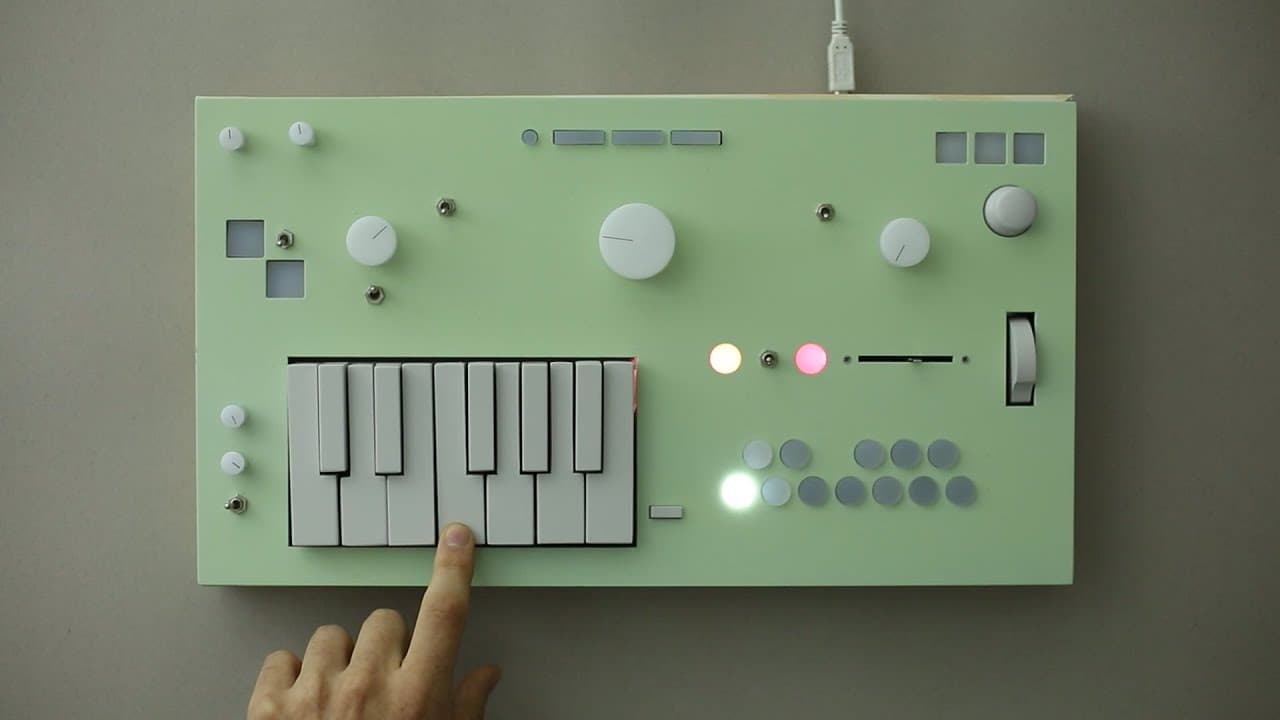

The Birth of the Nopia MK1
The music hardware industry is experiencing a significant breakthrough with the imminent arrival of the Nopia MK1. After capturing global attention in 2023 as a conceptual prototype designed by creators Martin Grieco and Rocío Gal, this synthesizer is preparing for its official commercial release at the end of 2026. With an estimated starting price of 550 British pounds, the device abandons the traditional format to propose an ecosystem based entirely on modular harmonic control.
Architecture and Synthesis Engines
The central interface dispenses with conventional multi-octave keyboards. Instead, the workflow is structured through three fundamental components: the Chord Builder (a one-octave keyboard), a twelve-button Tonal Selector, and an Extensions Dial. This configuration allows producers to execute complex progressions with just two fingers. The system integrates virtual analog and sample-based synthesis engines, operating simultaneously across four internal modules: keys, bass, arpeggios, and pads.
The goal is to allow a performer to trigger complex harmonic movements without requiring full keyboard technique.
— Martin Grieco
Tactile Expressiveness and Connectivity
To maximize live dynamics, the Nopia MK1 incorporates capacitive touch surfaces. A strum plate in the upper right corner stands out, allowing for the isolation and execution of individual notes within an active chord. Additionally, a polyphonic slider facilitates the application of pitch bends over entire chords, a rare feature in hardware of this segment.
- Strum plate for real-time melodic chord execution.
- Integrated effects: delay, reverb, tape emulation, and beat repeat.
- Independent MIDI output per module via TRS connections.
- OLED screen for visual feedback of harmonic parameters.
Impact on the Production Ecosystem
The arrival of this device marks a transition toward more organic user interfaces within sound design. By functioning as a harmonic groovebox without a percussion section, the instrument drastically accelerates the polyphonic composition process. Its ability to send multi-channel MIDI data positions it not only as a standalone synthesizer but as a sequencer brain capable of controlling complex hardware setups without relying on a central computer.