
Recently, the sound design landscape has witnessed an unprecedented advancement that blurs the line between psychoacoustics and music production. Developer and inventor Jelle Akkerman, through his technology label every something, has introduced Otophon. It is an innovative experimental plugin designed to generate otoacoustic emissions (OAEs), a physical phenomenon where the listener's own inner ear produces phantom frequencies.
Far from being a simple spatial emulator, this tool turns the human cochlea into an active component of the synthesis process, acting as a biological oscillator or wetware. By emitting two simultaneous tones with a specific phase shift, the plugin forces the ear to generate a third perceptible sound, academically known as the "Tartini tone."
The ecosystem developed by Jelle Akkerman does not emerge from nowhere. Based in northern Italy, this engineer and artist has been building a catalog of tools under the every something brand that defy the conventions of music software. Before the arrival of Otophon, the brand had already cemented its reputation with Eurorack hardware modules and plugins like Glosso and Artikulation, focused on chaotic vocal synthesis and polymetric rhythms. Otophon inherits this non-normative design philosophy, presenting a minimalist black-and-white interface that hides an extremely complex mathematical engine.
Technical Architecture and Stochastic Behavior
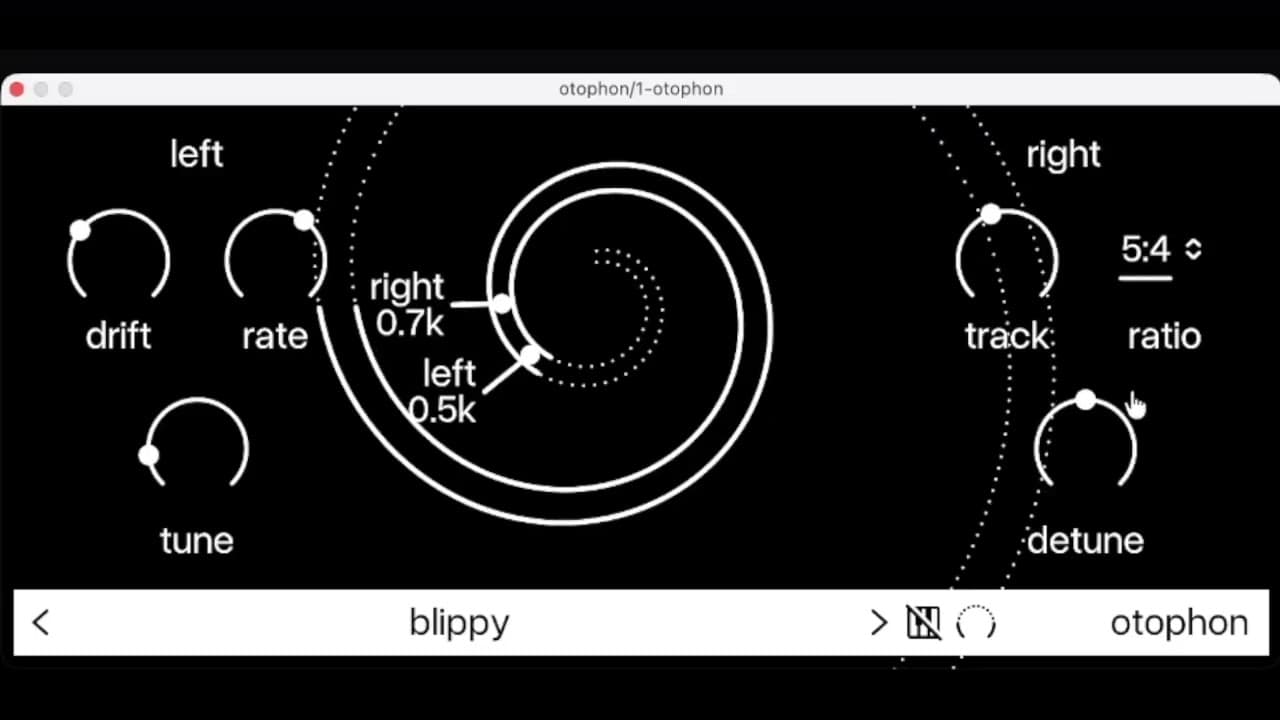
At an architectural level, Otophon moves drastically away from conventional subtractive synthesizers. The main engine is based on two interdependent oscillators. The left side sets the base frequency, while the right operates via a phase-locked loop. Instead of being rigidly quantized to a static MIDI input, this second oscillator constantly struggles to track the main pitch, generating organic and perpetual modulation.
The control panel offers parameters designed to tame this controlled chaos:
- Tracking Control: Adjusts the tracking sensitivity between frequencies, determining the speed of fluctuation.
- Drift Parameter: Introduces stochastic behavior, described by the creator as a 'lazy walk', to humanize the generated signal.
- West Coast Filters: The signal path passes through low-pass gates (LPGs) characteristic of Buchla-style synthesis, giving a percussive and elastic character to the transients.
According to official specifications, the optimal starting point for triggering the psychoacoustic phenomenon is found in mathematical ratios of 11:9 or 9:8. To experience total immersion, engineers recommend forgoing traditional headphones and using large-format studio monitors at a considerable volume. Sound pressure in the air is fundamental to efficiently activate the mechanical response of the inner ear.
Anatomy of Otoacoustic Emissions
Otoacoustic emissions (scientifically known as DPOAEs) are a documented physiological response. When the cochlea receives two pure tones simultaneously at a high sound pressure level, the outer hair cells act as a non-linear amplifier. This cellular process generates a distortion tone that travels in reverse, from the cochlea to the middle ear canal.
By isolating and manipulating this phenomenon through Otophon's code, Akkerman has managed to make the listener hear underlying melodies that seem to materialize directly in the center of the skull, completely independent of the physical speakers. Within production environments like Ableton Live or Logic Pro, the behavior of this VST requires a unique compositional approach. The plugin includes a Drone mode designed specifically to sustain frequencies and facilitate tuning the effect. Since the phenomenon depends entirely on the listener's individual anatomy, the perception of the third tone varies from person to person.
Psychoacoustic Impact on Sound Design
Historically, the exploration of otoacoustic emissions had been relegated to the experimental avant-garde of pioneering figures like Maryanne Amacher, or to strict medical applications for assessing hearing loss and tinnitus. However, the arrival of Otophon in native AU and VST3 formats democratizes this scientific technique for contemporary electronic music producers.
The distortion you perceive occurs physically inside your ear, not in the audio signal. The human body is now an oscillator.
— every something
This literal integration of biology into the workflow opens up a range of unprecedented possibilities for club music. The ability to inject frequencies that physically resonate within the audience's auditory system promises to transform deep techno, IDM, and ambient sessions into absolute bodily experiences. The resulting textures possess a natural saturation that no digital emulation can replicate, redefining the physical limits of immersive sound design and confirming that the next frontier of music technology resides in our own body.