
The Fusion of Visual and Musical Control
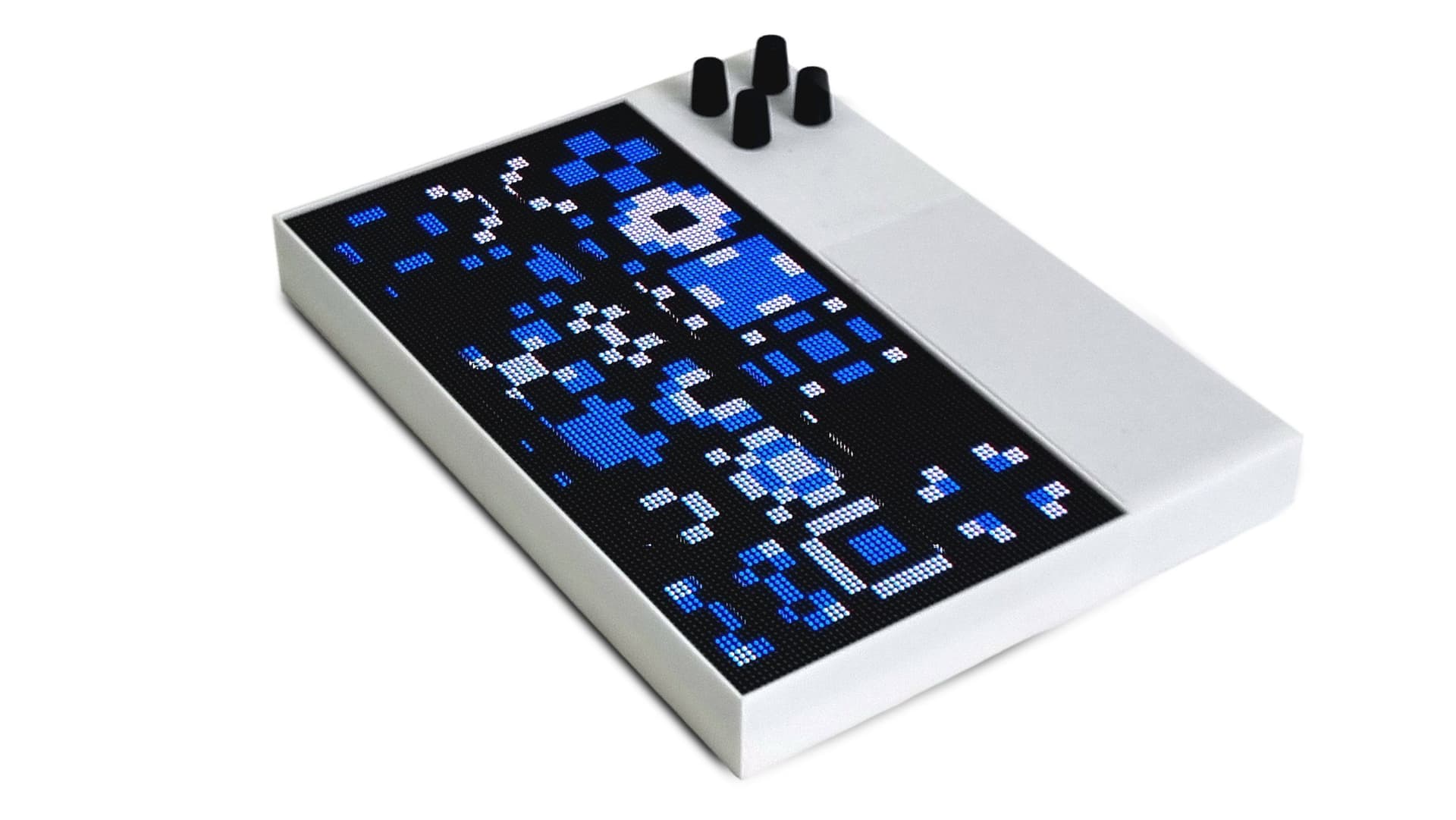
Recently, the open hardware community has witnessed the official launch of Patternflow, an innovative light synthesizer and musical controller. Developed under an open-source scheme by the engineer and artist known as engmung, the device began its funding campaign on the Crowd Supply platform on August 25, 2026. Unlike traditional synthesis equipment oriented toward audio generation, this unit does not emit sound itself. Its primary function lies in generative visual synthesis and the control of musical parameters through a 128x64 RGB HUB75E LED matrix, which translates to over 8,000 active pixels. All processing is managed internally by an ESP32-S3 microcontroller, which calculates each frame in real-time without requiring prior rendering.
The hardware design is structured for tactile immediacy. The physical interface consists of four rotary encoders connected directly to the mathematical algorithms of the visual pattern. By turning a potentiometer, the image distorts, changes color, or alters its geometry instantaneously. This approach transforms light into an instrument that can be played live, moving away from the simple playback of pre-recorded video to approach the pure improvisation that defines classic modular synthesis.
Open Architecture and Bidirectional OSC Communication
The technological core of Patternflow stands out for its ability to communicate bidirectionally using the OSC (Open Sound Control) protocol over local Wi-Fi networks. This feature allows users to send and receive data in real-time without the need for additional audio interfaces or physical cables. Physical movements on the device's controls are transmitted instantly to digital audio workstations (DAW) and visual programming environments. The system is fully compatible with industry-standard software such as Ableton Live, Max/MSP, and TouchDesigner.
To facilitate its integration into professional setups, the package includes a preconfigured Max for Live device. The development of these software tools included contributions from the community, including collaborations with technical profiles and DJs like Kaskobi. This connectivity allows visual parameters to synchronize perfectly with the BPM and groove of any live set. A producer can assign a Patternflow potentiometer to open the filter of a synthesizer in their DAW, while the same movement simultaneously alters the color palette of the LED matrix.
Patternflow began with the inspiration of Nam June Paik's Participation TV (1963), the first work where the public could touch the image.
— engmung (Project Creator)
- ESP32-S3 processor with integrated Wi-Fi connectivity for OTA (Over-The-Air) updates.
- 128x64 pixel RGB HUB75E LED matrix (8,192 pixels total).
- Native bidirectional support for OSC and advanced MIDI mapping.
- 100% open code: availability of STL files, PCB schematics, and firmware.
The Impact of Light Synthesis on the Clubbing Ecosystem
The open-source nature of the project democratizes access to professional-level tools. The 3D printing files, printed circuit board schematics, and source code are publicly available in the creator's GitHub repository. The cost of components for manual assembly is around 100 dollars, while the pre-assembled units offered in the funding campaign were set at 269 dollars. Additionally, the internal Pattern Lab platform allows for programming new modules in JavaScript that are automatically compiled to C++, optimizing performance without needing to restart the equipment.
The arrival of modular equipment like Patternflow redefines interaction on electronic music stages. By allowing a visual controller to also act as a control signal emitter, historical technical barriers between VJing and DJing are eliminated. This convergence is especially attractive for independent labels, event promoters, and creators of immersive installations who seek absolute synchrony between lighting and rhythmic structure. The possibility for light to respond organically to music, or for the performer to manipulate the dance floor from a light panel, sets a new standard in the design of audiovisual experiences.