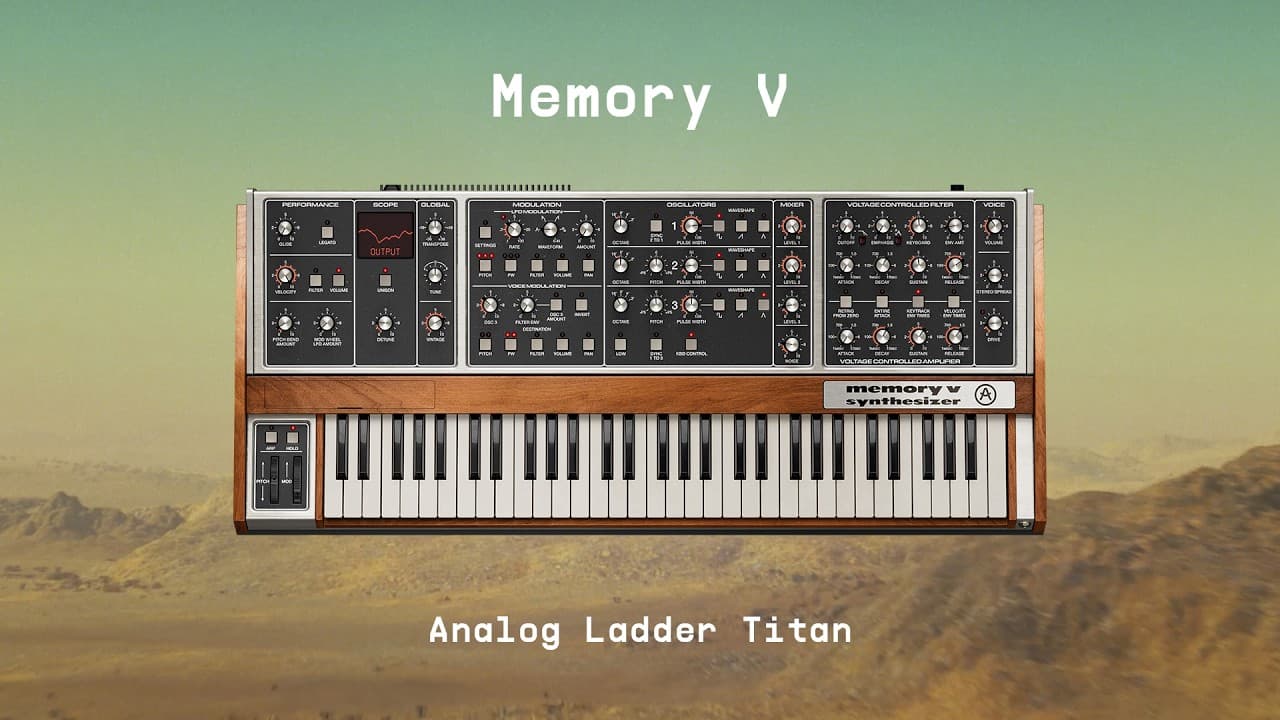

The digital rebirth of an analog giant
The French company Arturia has recently announced the release of Memory V, a new virtual instrument that accurately emulates the historic Moog Memorymoog polyphonic synthesizer, originally marketed in 1982. This development allows electronic music producers to integrate the characteristic dense sound of the original hardware directly into their digital audio workstations (DAW).
Sound architecture and technological improvements
According to the manufacturer's official documentation, Memory V uses patented TAE (True Analog Emulation) technology to replicate the unstable behavior and warmth of the original circuits. The software maintains the classic three-oscillator-per-voice structure and the renowned Ladder filter, while implementing expansions designed for contemporary workflow.
- Expanded polyphony from six to twelve voices.
- Advanced modulation system via drag-and-drop.
- Incorporation of a four-layer multi-arpeggiator.
- Full compatibility with MPE, NKS, and MTS-ESP formats.
- More than 17 integrated effects modules, including reverb and distortion.
Memory V captures the colossal analog character and three-oscillator architecture of the legendary 1982 Memorymoog in exceptional detail.
— Official Arturia press release

Start playback
Modern stability for a historic sound
The arrival of this emulation solves the well-known reliability and maintenance issues presented by the physical equipment from the eighties. With a starting price set at 149 euros, Memory V democratizes access to a high-density sound engine, offering current sound designers a stable tool that combines the weight of analog audio with the flexibility of modern software.