
Analog synthesis in pocket format
Behringer has once again shaken up the music hardware industry this week with the official presentation of the D MINI, an ultra-compact reinterpretation of the legendary Minimoog. Designed for producers constantly on the move and live performers, this device encapsulates the iconic sound that defined decades of electronic music in a portable chassis, maintaining rigorous sonic fidelity to the circuits of the original model that revolutionized synthesis in the seventies.
Technical architecture: Three oscillators and ladder filter
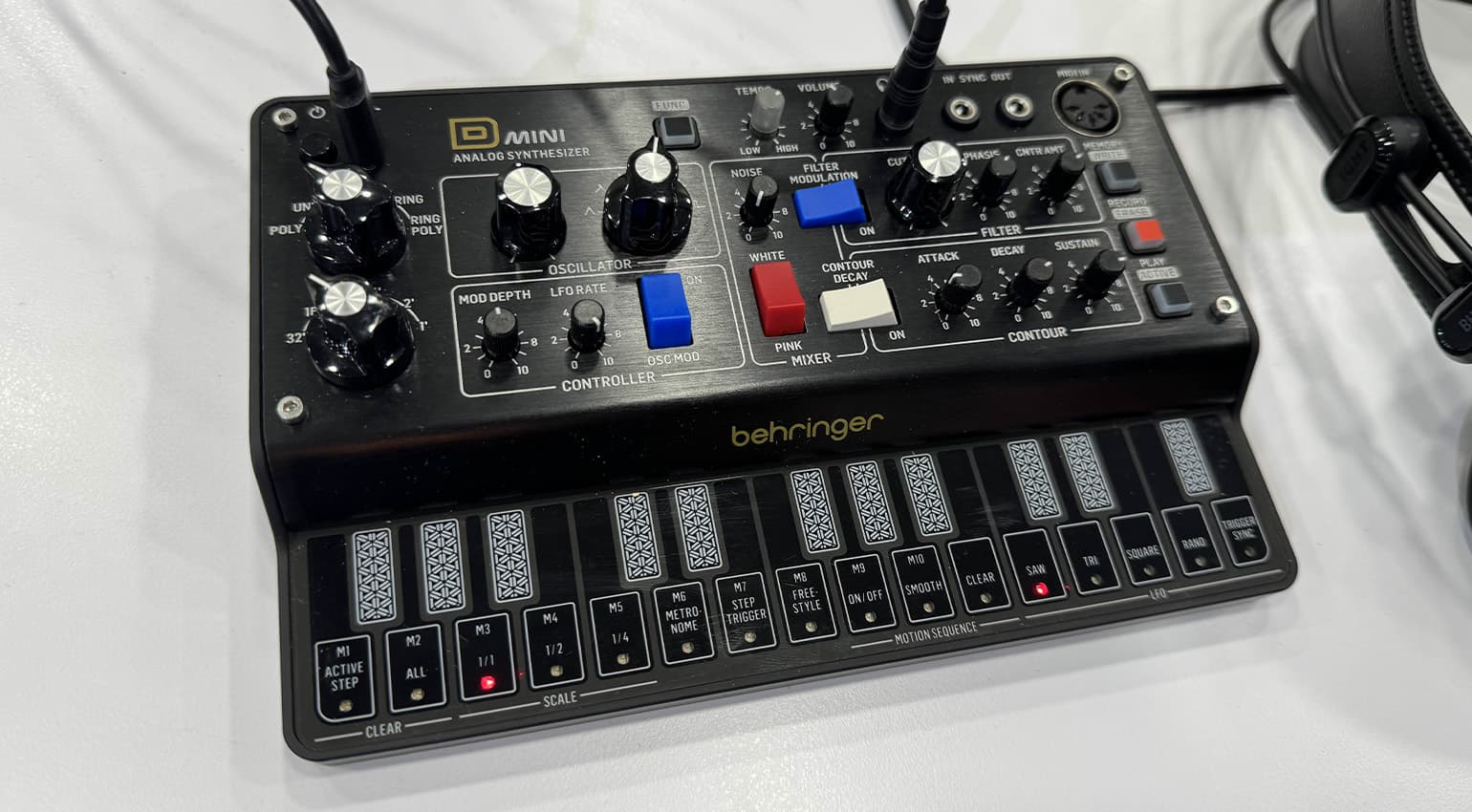
True to the classic architecture, the D MINI's sound engine is powered by three analog oscillators with paraphonic operation capability. Users can explore five independently selectable waveforms (sawtooth, triangle, sharktooth, square, and pulse), ensuring a versatile sound palette for building deep bass lines and cutting leads. The core of its timbral character lies in the authentic 24 dB ladder low-pass filter with resonance control, directly responsible for the aggressive textures and harmonic sweeps characteristic of the hardware from the golden age of analog.
To complement the signal chain, the unit expands creative possibilities by incorporating a white and pink noise generator, a dedicated ADS-type envelope for the voltage-controlled amplifier (VCA), and a low-frequency oscillator (LFO) with four waveforms. In terms of physical interface, the front panel offers 18 direct tactile controls and a 27-key capacitive keyboard. Its power is conveniently managed via USB-C connectivity, allowing for uninterrupted use via external batteries in any production environment.
Start playback
Advanced sequencing and MIDI connectivity
One of the most notable innovations compared to its predecessors is the inclusion of an integrated step sequencer with motion sequencing capability. This feature, added to its various voice modes that include three-voice paraphonic operation, unison mode, and ring modulation, turns the synthesizer into a standalone workstation. Furthermore, its full MIDI implementation allows every potentiometer to transmit control change (CC) data, facilitating absolute integration with modern digital audio workstations (DAW).
A strategic blow to the music hardware market
With a starting price set at 99 euros for the European market, the corporation continues its aggressive and successful strategy of miniaturizing historic synthesizers. The device not only challenges the economic barriers to entry for purely analog production, but also sets a new standard for portability within the clubbing ecosystem and small-format live performances. For the new generation of creators and sound purists, the D MINI represents democratized access to legendary textures without compromising financial integrity or physical space in contemporary studios.