
The Four-Deck Challenge on the Pioneer DJM-S11
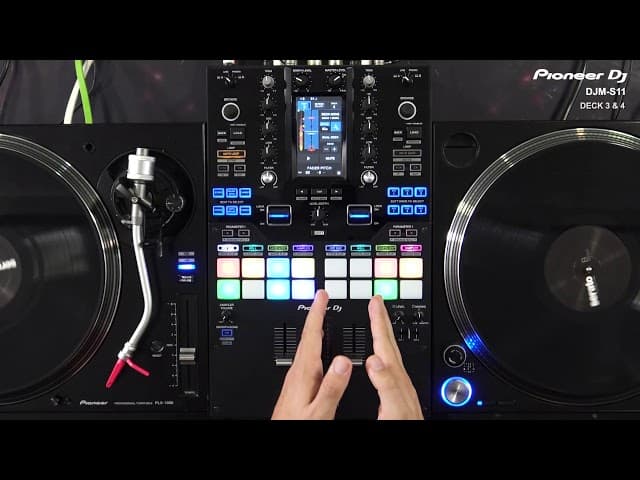
The Pioneer DJM-S11 has established itself as an undisputed standard in open-format and turntablism booths. Despite being a two-channel physical mixer, its powerful internal engine allows for the control of up to four simultaneous decks using leading platforms like Serato DJ Pro or Rekordbox. However, accessing Decks 3 and 4 traditionally requires navigating the submenus of its 4.3-inch touchscreen. Using native functions like 'Deck 3/4 Control' or 'Dual Deck' involves looking away from the audience and performing multiple taps on the interface, a process that drastically interrupts the workflow during complex transitions at high BPMs.
To overcome this limitation, the deejay community has been seeking alternatives that allow for tactile and immediate access. Recently, through an intense debate originating on the specialized subreddit r/DJs, various users shared an unorthodox but highly effective solution: the integration of Elgato Stream Deck Studio hardware to externalize and map these commands in a dedicated way.
MIDI Mapping and Dedicated Tactile Control
The Elgato Stream Deck Studio, launched in September 2024, was initially designed to meet the rigorous demands of professional broadcasting. Presented in a standard 1U rack format, this device features 32 fully customizable LCD keys, PoE+ connectivity for power and data via a single cable, an integrated NFC reader, and two rotary dials. By adapting this equipment to the DJ booth and assigning its additional buttons via the MIDI protocol, artists have achieved absolute control over the transport, synchronization, and cueing functions of the auxiliary channels.
- Direct assignment of transport controls (Play, Cue, Sync) without touching the touchscreen.
- PoE+ connectivity that reduces cable clutter in the booth.
- Real-time visual feedback through the 32 integrated LCD screens.
- Freeing up the main mixer to focus on equalization and scratching.
This hardware hacking tactic completely frees up the main controls of the DJM-S11. By delegating secondary functions to an external surface, the artist can maintain their focus on the precise equalization of channels 1 and 2, the intensive use of Performance Pads for finger drumming routines, and the millimeter handling of the Magvel Fader Pro crossfader. Furthermore, muscle memory is greatly reinforced thanks to dynamic visual feedback, allowing for the assignment of colors or record label logos to each key.
The Obstacle of the Subscription Model
Despite the undeniable advancement in ergonomics and creativity that this setup provides, the solution has generated deep polarization within the community. The first hurdle is the economic barrier to entry: the Elgato Stream Deck Studio has a market price of around 999 euros, which represents a considerable investment for an auxiliary controller that does not produce sound itself.
Added to this is the restrictive software ecosystem necessary for its optimal operation. The device depends on integration with Bitfocus Companion and its native Buttons program to manage complex routing. According to reports from users who have implemented this system, unlocking the full potential of advanced macros requires the payment of high-cost perpetual licenses (close to 500 euros) or submitting to a monthly subscription model.
Modular Innovation Versus Commercial Barriers
The convergence between high-end live streaming equipment and the professional DJ ecosystem demonstrates the constant and desperate search for customization by artists. While traditional manufacturers in the electronic music industry tend to close their ecosystems to force the purchase of specific modular controllers, third-party tools like the Stream Deck Studio open the door to highly efficient hybrid configurations.
The experiment documented in forums demonstrates that current technology allows for blurring the lines between a television studio and a club booth. It remains to be seen whether major DJ technology brands will take note of this clear demand for accessible modular control, or if expensive corporate subscription models will end up stifling the technical creativity of independent artists.