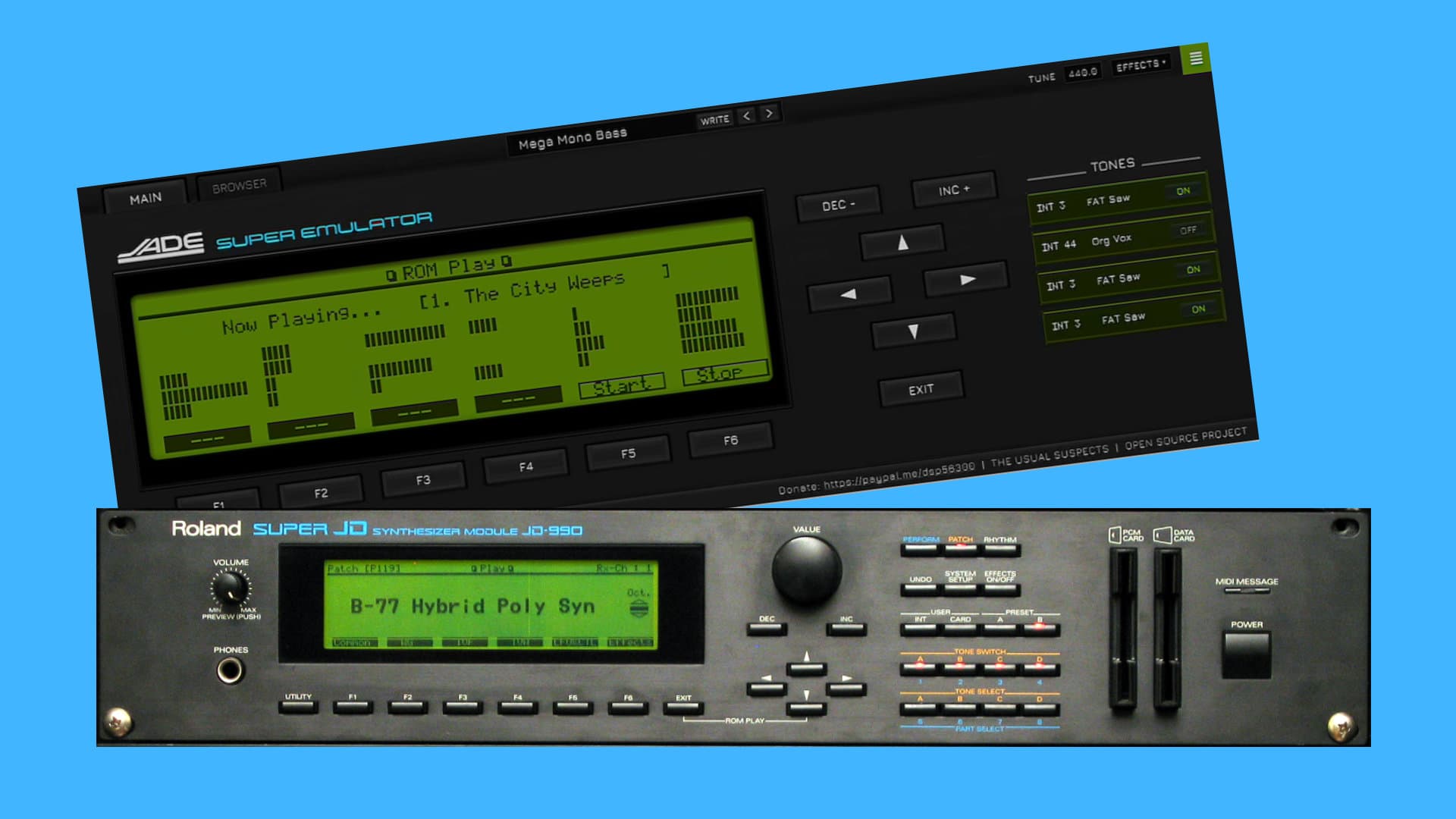

The Digital Rebirth of a Classic: JADE and the Legacy of the Roland JD-990
The landscape of electronic music production and sound design is witnessing a new milestone in the preservation of classic hardware. Recently, the collective of developers known as The Usual Suspects has announced the alpha phase release of JADE, a plugin-format emulation of the iconic Roland JD-990 synthesizer. This technological project has sparked immense interest in the global community of producers by bringing one of the most revered sound modules of the nineties to contemporary digital workflows.
JADE is not a simple analog modeling approximation, but a code recreation that seeks exact parity at the level of functional architecture with the original physical unit. According to the technical specifications shared by the developers through their official communication channels, the software is already available to project sponsors via their Discord server. The tool has been compiled to ensure its integration into current workflows.
- Supported plugin formats: VST2, VST3, AU, LV2, and CLAP.
- Multi-platform compatibility: macOS, Windows, and Linux.
- Native support for reading and importing original sound banks (.sys) from the 1993 hardware.
The Architecture of the Super JD: Recovering the Sound of 1993
The original Roland hardware, released to the market in 1993, was commercially dubbed the 'Super JD'. It was conceived as an expanded and perfected rack-mount version of the successful JD-800 keyboard. The complexity of its synthesis engine quickly made it a centerpiece in recording studios focused on the nascent European clubbing ecosystem. Historical electronic music groups, such as the British act Faithless, cemented immortal dance floor anthems using the precise and cold digital textures of this machine.
Technically, the Roland JD-990 stands out for offering 195 PCM waveforms, oscillator synchronization, cross-modulation, and ring modulation. Additionally, it incorporates an integrated multi-effects processor that includes three-band graphic equalization, distortion, phaser, chorus, delay, and reverb. One of the features most appreciated by mix engineers is its multi-mode TVF filter, which allows for sculpting much more complex frequencies than its predecessor. Each sound patch can be composed of up to four tones, making this 24-voice polyphonic multitimbral module a tool of immense institutional weight for creating grooves and dense atmospheres.
Reverse Engineering and Digital Heritage Preservation
The team behind JADE, The Usual Suspects, has forged a solid reputation in the industry thanks to their reverse engineering work. Previously, the group jumped to the technological forefront with the DSP56300 project, through which they managed to emulate the eponymous Motorola processors used in virtual analog hardware synthesizers. From that initiative, acclaimed plugins were born that are already a standard in many studios, such as Osirus (which emulates the Access Virus A, B, and C series), Vavra (Waldorf microQ), and JE-8086 (Roland JP-8080).
The group's approach transcends mere commercial software development; it is a rigorous initiative of historical preservation. In their own institutional statements regarding their mission, the collective highlights their primary motivation in favor of synthesizer history:
We are a dedicated group of people who are currently reverse engineering and emulating various DSP processors that have been used in the design and implementation of digital musical instruments and effects processors over the years.
— The Usual Suspects
Timbral Relevance for the Dance Floors of Tomorrow
The arrival of JADE to the VST ecosystem underscores an undeniable trend in contemporary electronic music production: the search for digital warmth and the sonic idiosyncrasy of the nineties. The JD-990 possessed a feature highly valued in its time, the ability to introduce pitch drift similar to the instability of analog circuits, providing an organic texture to chord sequences, pads, and synth basses.
By offering a faithful and accessible emulation, the development of JADE democratizes access to a sound that defined fundamental record labels of electronic culture. Lacking confirmation of a definitive public release date for its stable version, the current alpha phase already demonstrates remarkable solidity and confirms that the legacy of nineties digital synthesis remains an immovable pillar in the evolution of studio tools.