
Beyond SPL: The redefinition of coverage in Hall 8
This year's edition of Integrated Systems Europe (ISE) at Fira Barcelona Gran Via has confirmed a trend that we systems engineers have been observing for five years: the volume war is over; the spatialization war has begun. At the d&b audiotechnik stand, and more specifically in its satellite demo rooms, the focus has shifted from the raw power of traditional line arrays to focus on phase management and psychoacoustic positioning. The German firm has presented the latest firmware updates for its DS100 Signal Engine processor, the heart of its Soundscape system, demonstrating that immersive audio in clubs and large venues is no longer an experiment, but a robust and viable engineering standard for touring.
The most relevant aspect in terms of system architecture was the demonstration of the new network protocol integration. While years ago the discussion focused on Dante latency, d&b has doubled down on Milan (AVB) as the backbone for deterministic audio transmission. The new network bridges presented allow for critical signal redundancy for live environments, ensuring that packet loss is mathematically impossible in the digital signal chain, from the mixing console (FOH) to the D-Series amplifiers. For the tuning technician, this means superior clocking stability and a drastic reduction in 'jitter' over long fiber optic runs.
We are not designing speakers to sound loud, but to disappear acoustically. The goal of the DS100 is for the audience to locate the sound at the visual object, not at the hung box.
— Ralf Zuleeg, Head of Sales Services & Application Engineering at d&b
DS100 Update: En-Scene and automation
Entering the processing engine specifications, the improvements in the En-Scene software module are notable. The object positioning algorithm now manages DSP resources more efficiently, allowing for the rendering of up to 64 simultaneous sound objects with a total system latency of less than 1.3 ms (analog to analog). This is crucial for electronic music applications in clubs, where the 'timing' between the visual and auditory kick drum must be surgical. In addition, the management of the 'Level Shell' has been improved, allowing engineers to sculpt how the energy of a sound object decays as it moves away virtually, avoiding the dreaded destructive 'phasing' effect when multiple sources are summed in a 360-degree distributed array.

Start playback
Hardware: The A-Series as a spectral fill tool
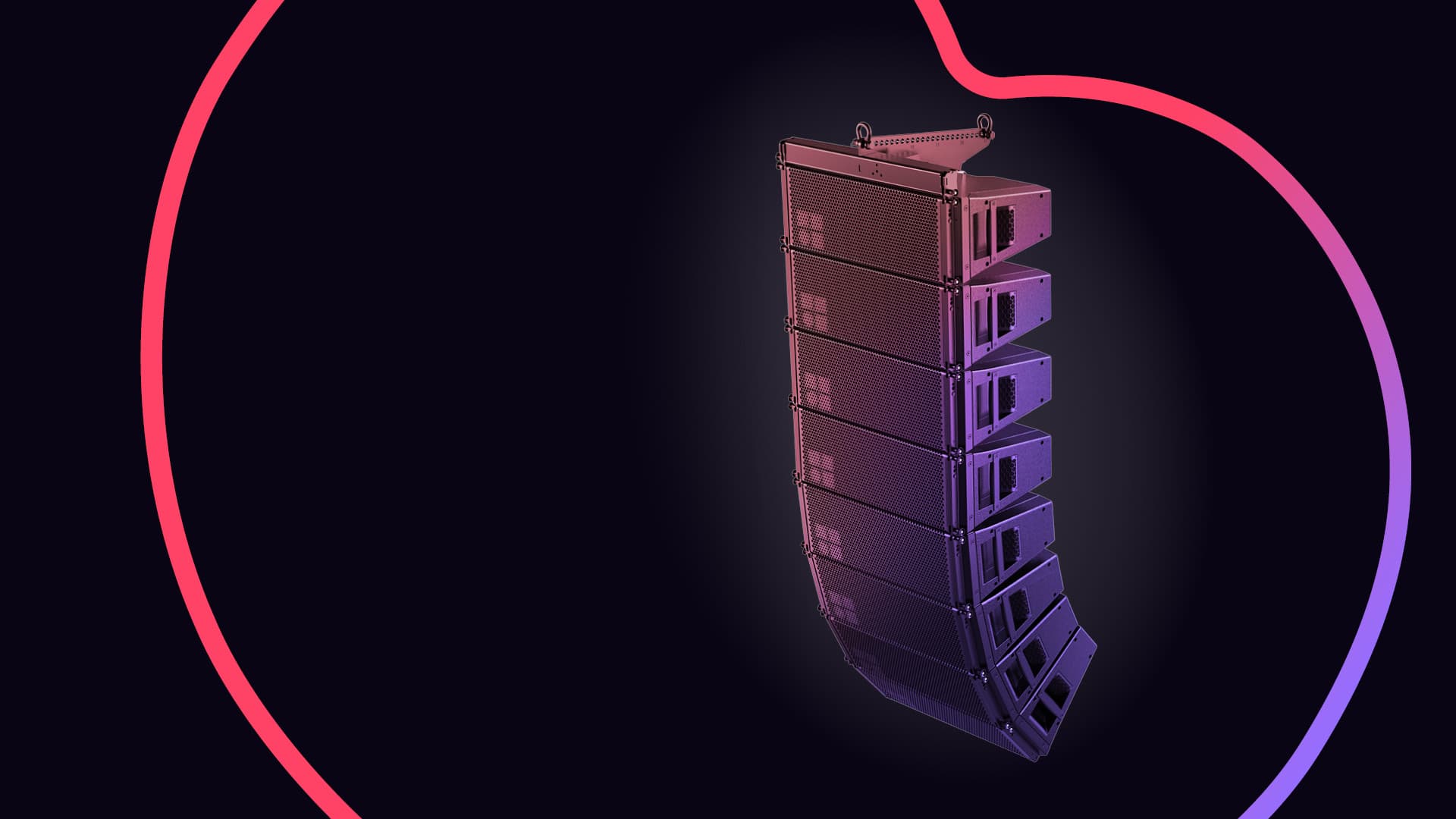
In the transducer section, although there were no 'big box' launches like a theoretical successor to the GSL series, emphasis was placed on the application of the A-Series (Augmented Array) in immersive contexts. These speakers, with their variable directivity control through mechanical dispersion adjustments (Midrange Directivity Control), are positioned as the key piece to cover dead zones in complex club designs. Their coherent phase response and ability to maintain intelligibility in the 200Hz-2kHz range make them ideal as 'front fills' or surround speakers in Soundscape configurations, where tonal consistency with the main PA is critical to maintaining the immersive illusion.
Market comparison: d&b vs. L-Acoustics L-ISA
It is inevitable to compare what was seen at the d&b stand with the proposal of its direct French competitor, L-Acoustics, also present at the fair with L-ISA 3.0. While L-Acoustics seems to focus on vertical integration with its own consoles and a highly polished closed ecosystem, d&b continues to bet on a more agnostic architecture through VST/AU/AAX plugins that integrate into any DAW or console (DiGiCo, Avid, SSL). From the 'freelance' engineer's point of view, d&b's flexibility to integrate via OSC (Open Sound Control) with third-party tracking systems (such as BlackTrax) still seems slightly superior, offering a granularity of control over delay and gain parameters per object that satisfies the most obsessive technicians.
In conclusion, ISE 2026 has shown that the industry has moved past the 'novelty' phase of immersive audio. It is no longer about selling the 'wow' effect, but about offering workflow tools that allow these complex systems to be set up, tuned, and dismantled as quickly as a traditional stereo system. d&b audiotechnik has made it clear that its priority is digital workflow efficiency and the robustness of signal transport over IP, cementing its position as the technical standard for the next generation of 'super-clubs' and boutique festivals.