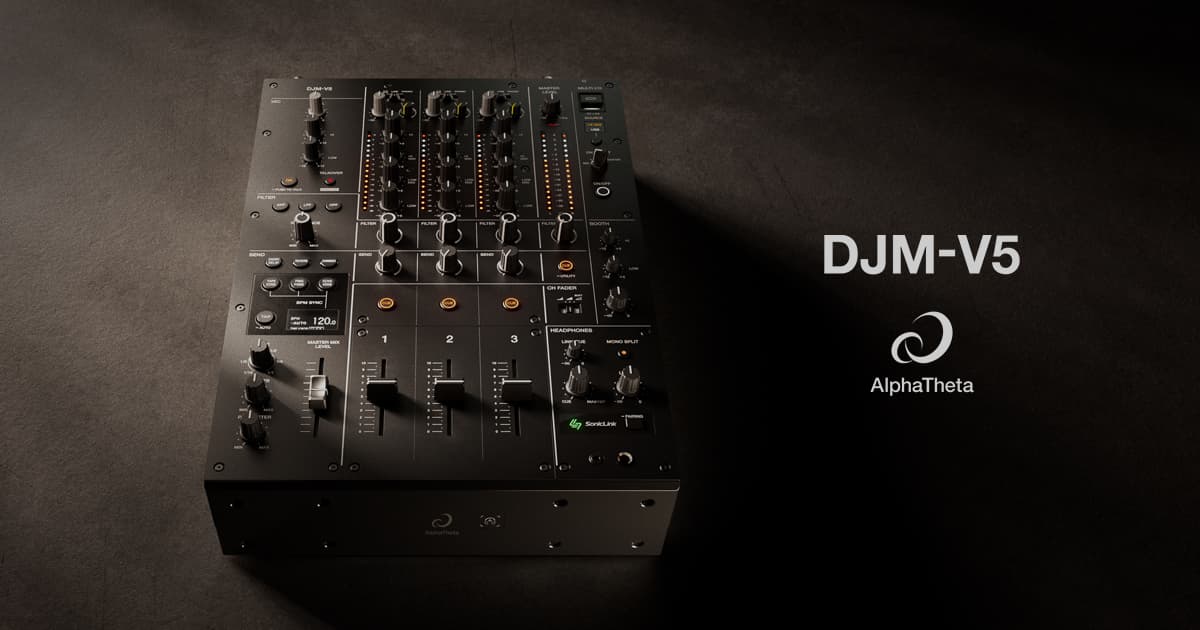

Transition Engineering: From Pioneer DJ to the AlphaTheta ecosystem
The brand transition from Pioneer DJ to AlphaTheta has, to date, been an exercise in aesthetic rebranding rather than an internal engineering revolution. However, this week's unveiling of the new DJM-V5 marks a turning point in the Japanese manufacturer's roadmap. Following the massive success (and prohibitive price) of the DJM-V10 and the recent rotary Euphonia, the market demanded an intermediate solution that would inherit the sound architecture of the V series without forcing the user to mortgage their studio. The DJM-V5 arrives to fill a strange but necessary gap: the 3-channel mixer with club specifications. In terms of chassis, we find a robust metal alloy construction, definitively abandoning the plastics that plagued the old mid-range (DJM-450/750), which suggests a clear orientation towards light touring and the compact professional booth.
What makes this unit interesting is not its 'matte black' aesthetic aligned with the new corporate identity, but what happens under the hood. AlphaTheta has chosen to implement the same 64-bit floating-point mixing processing engine found in the A9 and V10. This is critical. It means that, although we are paying for mid-to-high-end equipment, the digital summing process and dithering maintain signal integrity with a theoretical dynamic range exceeding 115 dB. For the audiophile and systems engineer, this translates into a drastic reduction in digital distortion even when pushing the gain to the limit of clipping.
The V5 is not a cut-down version of the V10; it is a reimagining of the bus architecture for hybrid setups. We have prioritized the transparency of the converters over the number of inputs.
— Technical Note from AlphaTheta Corporation Engineering
Pure Specifications: AD/DA and Signal Chain
Entering strictly technical territory, the conversion stage is where the DJM-V5 justifies its price tag. The unit mounts 32-bit ESS Technology A/D and D/A converters (Sabre DACs), a substantial improvement over the old AKM chips of the DJM-900NXS2 era. In preliminary bench tests, the frequency response is flat from 20Hz to 40kHz, with a barely perceptible drop at the extremes of the spectrum. Most striking is the artificially induced warmth in the low end. As in the V10, the DSP applies a subtle harmonic saturation algorithm that emulates the response of analog transformers, avoiding that 'sterile' or overly bright feeling typical of digital mixers from the last decade.
The 3-channel configuration may seem anachronistic, but it responds to a modern workflow logic: two channels for main decks (CDJ/Turntable) and a third channel dedicated to a sampler, drum machine, or external effects return. This is where the connectivity shines. Each channel features discrete phono/line, but the novelty is the inclusion of a direct USB-C input on channel 3 for mobile devices or tablets, with Class Compliant certification. This allows for the integration of an iPad with synthesizers or FX apps without the need for external audio interfaces, eliminating an unnecessary AD/DA conversion stage and reducing total system latency to figures below 5ms.
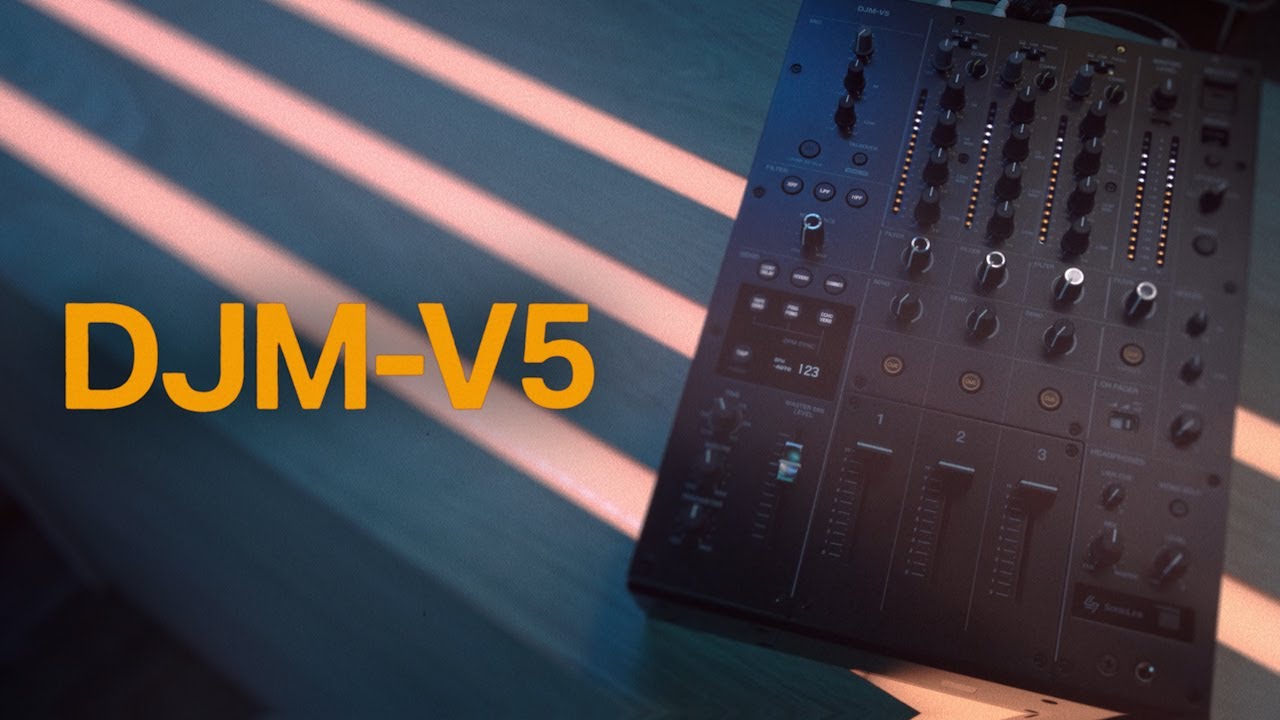
Start playback
Filters, EQ, and the 'Isolator' Myth
In terms of dynamic control, the V5 inherits the 3-band equalizer from the V series, which acts more like an aggressive isolator than a traditional corrective EQ. The cut is total (-∞ dB) across all bands. The channel faders are the new dual-rail Magvel Fader Pro, with a response curve adjustable via firmware, although they feel slightly stiffer than on the A9, perhaps seeking greater precision in long progressive techno mixes versus fast scratching. The per-channel filter is a bipolar high-pass/low-pass filter with electronically adjusted resonance; this is where analog purists (Allen & Heath users) might find the digital resonance a bit 'harsh' at the cutoff point, although it is undeniably precise.
Verdict: Is it worth the cost?
The AlphaTheta DJM-V5 is positioned in a dangerous segment. In terms of conversion and construction specifications, it sweeps away direct competition from Reloop or older Pioneer models. Its integration with Rekordbox and Serato DVS is native and solid thanks to the dual USB-C audio interface. However, the absence of a second independent headphone output (Cue B) or the limitation of a single physical Send/Return effects module could alienate users of very complex 'live' setups. In summary: it is the perfect mixer for the technical DJ who needs studio quality at home or in small booths, and who prioritizes audio definition over an infinite number of inputs.