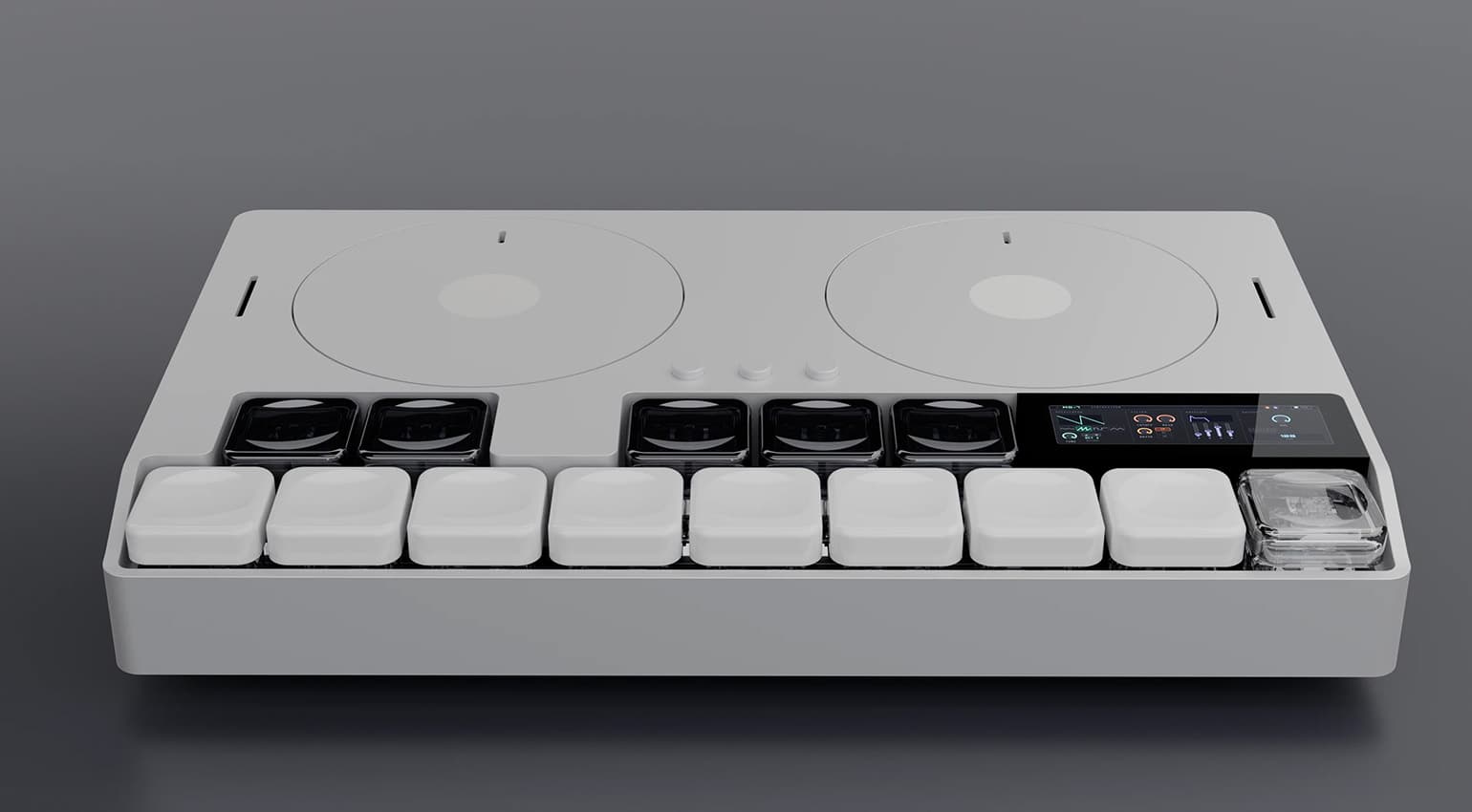

The Tactile Future of Music Production
The emerging Hong Kong-based tech company, Mach Devices, has burst onto the music hardware market with the announcement of its new device: the MD-7. This pocket synthesizer, which has already gathered a community of over 12,000 followers on its official social media channels, proposes a paradigm shift in the physical interaction between the producer and the machine, betting on motorized haptic controls and a completely open development environment.
Haptic Engineering: FOC Motors and Dynamic Resistance
The core of the MD-7's innovation lies in its two rotary discs driven by Field Oriented Control (FOC) motors. Unlike traditional potentiometers, these discs do not just register user movement, but actively communicate through tactile feedback. The resistance of the controls varies in real-time depending on the parameter being modified within the modulation matrix or the sequencer.
This electromechanical system allows for the simulation of physical clicks for stepped values, such as waveform selection, or the generation of "virtual walls" when the limit of a cutoff filter is reached. The technical intention of the developers is to shift visual attention from the screen to the muscle memory of the hands during studio sessions or live performances.
Stop looking at the screen. Start feeling the patch. Your muscle memory meets the precision of the machine.
— Official Mach Devices Manifesto
Open-Source Architecture and Technical Specifications
At the software level, the MD-7 is a transparent ecosystem. The firm has confirmed that the Digital Signal Processing (DSP) engine, the modulation matrix, and the sequencer will be released as open-source via public repositories on GitHub. This allows the global developer community to modify, fork, or rewrite the firmware from scratch, eliminating the usual restrictions of closed systems.
Regarding its factory sound capabilities, the device includes a subtractive synthesis engine equipped with four oscillator waveforms, a resonant multimode filter, and a standard ADSR envelope. Added to this is a 16-step sequencer and a percussion looper, whose tracks can be manipulated live using the motorized discs, emulating turntablism techniques.
The physical hardware specifications detail a construction focused on portability and millimeter precision:
- 1.65-inch IPS screen at 273 PPI, designed to display envelope curves and oscilloscopes with a wide viewing angle.
- RGB backlit keyboard composed of 13 buttons covering a full octave, plus three additional function buttons.
- Chassis available in two finishes: 3D-printed PETG plastic or a premium version in CNC-machined aluminum.
Impact on the Electronic Hardware Ecosystem
The launch of the MD-7, scheduled for late September 2026, marks a milestone in the democratization of high-end control technologies. Historically, motorized faders and controls were reserved for large-format studio mixing consoles. By integrating this FOC technology into an ultra-portable format, Mach Devices directly challenges the established standards in the compact groovebox sector.
With an entry price of around 399 US dollars for its PETG plastic version and 479 dollars for the aluminum one, the MD-7 not only offers a robust synthesis tool but a hackable platform that redefines the tactile relationship with sound design in contemporary electronic music.