
The evolution of sound design: reFX presents Rippler
The music software development company reFX, globally recognized for its successful virtual instrument Nexus, has announced the official launch of Rippler. This new dual-architecture synthesizer is designed to emulate real acoustic instruments and create imaginary sound textures through an advanced physical modeling engine. The manufacturer's proposal moves away from sample-based libraries to delve into real-time sound generation, combining the physical behavior of materials with the flexibility of traditional subtractive synthesis.
Acoustic architecture: Exciters and resonators in series
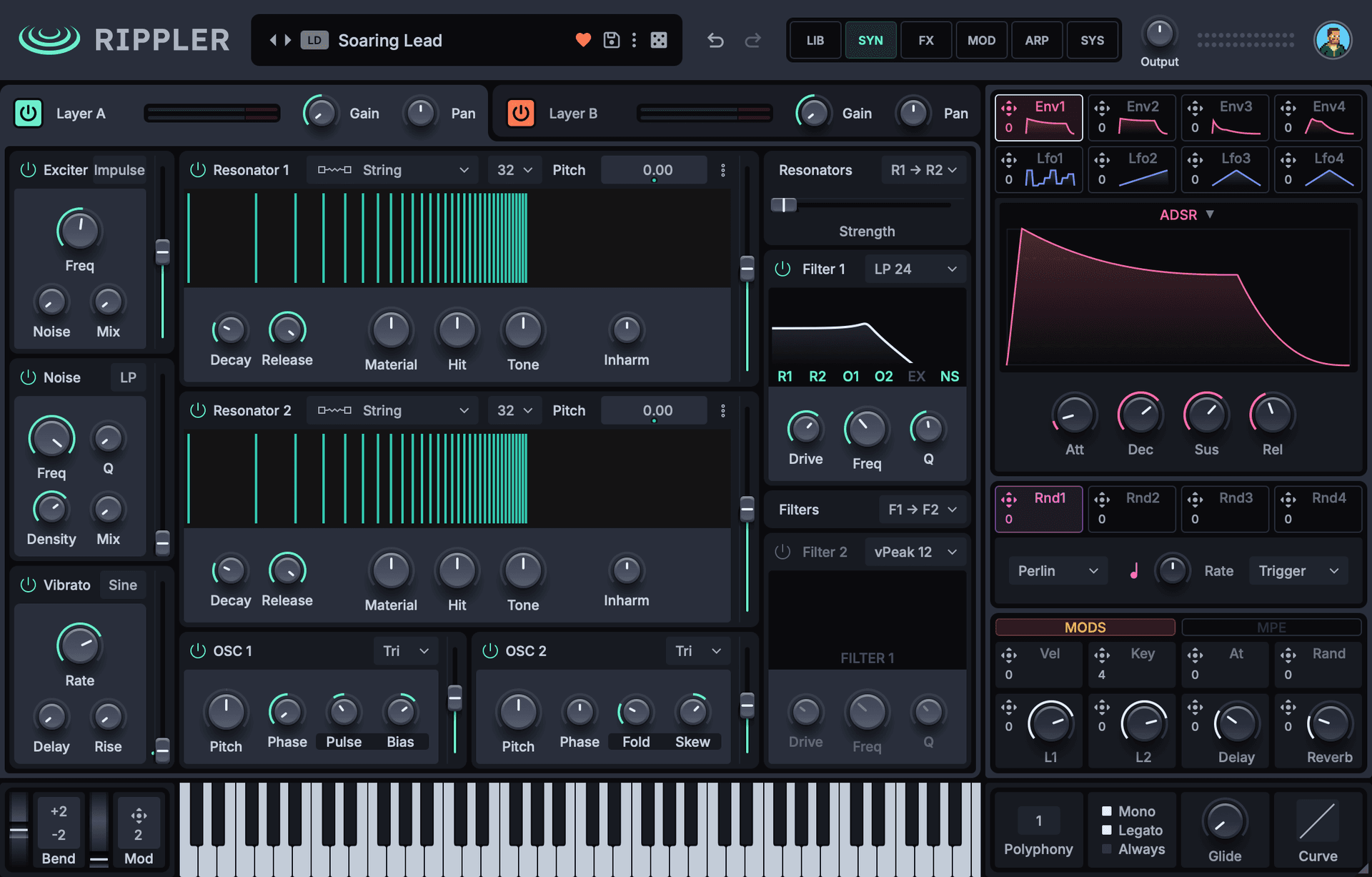
The core of the signal flow in Rippler is based on the principle of excitation and resonance. The sound is initiated through an exciter module, which allows for user sample import and features a sidechain input to inject audio directly. This signal feeds two resonators that mimic the acoustic properties of physical objects. The software includes twelve acoustic-style resonator models, including strings, beams, bells, membranes, drum skins, djembes, vibraphones, marimbas, and open or closed tubes. Furthermore, the resonators can operate in series or parallel, incorporating a bidirectional energy coupling that generates complex harmonics.
For more experienced sound designers, Rippler also offers a manual resonator mode intended for custom additive synthesis. In this mode, the user can modify the partials in frequency and level, and even drag the cursor to paint their own harmonic pattern on the interface, expanding the limits of acoustic emulation into purely experimental territories. To complement the physical modeling, the audio engine integrates two subtractive synthesis oscillators equipped with phase, fold, and asymmetry controls. Frequency sculpting is managed through twenty-seven different filter types, ranging from classic analog ladder-style circuit emulations to modern vocal filters.
Polyphonic expressiveness and modulation ecosystem
One of the most notable technical features of Rippler is its full integration with the MPE (MIDI Polyphonic Expression) protocol. This compatibility allows producers to apply pitch bend, pressure, and slide independently for each note, providing a level of expressiveness fundamental for an instrument based on the physics of sound. The modulation matrix is extensive, offering four low-frequency oscillators (LFOs), four envelopes, random generators, and assignable macros with custom mapping curves. The system also allows key-tracking to be compressed, expanded, or remapped, radically altering how the instrument responds across different octaves.
- Thirteen studio effects distributed across three independent chains (Layer A, Layer B, and Master), covering equalization, distortion, stereoizer, phaser, compressor, chorus, magnetic emulation, tremolo, standard delay, Bucket-style delay, reverb, limiter, and a particle processor.
- Native support for microtuning through the import of Scala files (.scl or .kbm) and direct compatibility with MTS Client, facilitating composition in non-Western scales.
- Advanced arpeggiator that includes dedicated modifiers for velocity and pitch, allowing for complex evolving sequences.
- An optimized preset browser that incorporates tags by sound type, a favorites system, and a random selection function to inspire the creative process.
Impact on electronic music production
The arrival of Rippler represents a strategic move by reFX to capture sound designers and producers looking for organic and hybrid textures. Historically, the brand has dominated the ROMpler-based instrument market, so this foray into pure physical modeling demonstrates an adaptation to the current demands of the industry. Unlike standard wavetable synthesizers, physical modeling offers a dynamic response that reacts organically to performance, ideal for genres that require timbral depth such as melodic techno, ambient, IDM, or cinematic composition. The plugin is now available for Windows 10, Windows 11, and macOS operating systems in VST3, AAX, and Audio Unit formats. During its launch phase, it is being sold at an introductory price of ninety-nine dollars until September 13, 2026, with its regular cost subsequently set at one hundred and twenty-nine dollars.