
The Evolution of Sound Design
The music production industry has recently received news that promises to shake the foundations of contemporary sound design. The renowned software company reFX, celebrated in the global electronic scene for developing titanic and ubiquitous tools in studios like Nexus and Vanguard, has officially revealed the imminent arrival of its new virtual instrument: reFX Rippler. This innovative audio plugin delves fully into the complex and fascinating terrain of physical modeling combined with subtractive synthesis, offering producers a palette of organic, complex, and highly dynamic textures that escape traditional paradigms.
After several weeks of anticipation and mysterious visual teasers published on their various communication channels, the firm has dispelled the doubts. Recently, through a video titled RIPPLER - Preset Showcase hosted on their official YouTube profile, the immense capacity and sonic character of this new audio engine have been confirmed. In this extensive demonstration, the synthesizer showcases its ability to generate everything from crystalline percussion, resonant bells, and plucked strings with astonishing realism, to dense atmospheres, intricate rhythmic sequences, and punchy basslines designed to tear up the dance floors.
Hybrid Architecture and Technical Specifications
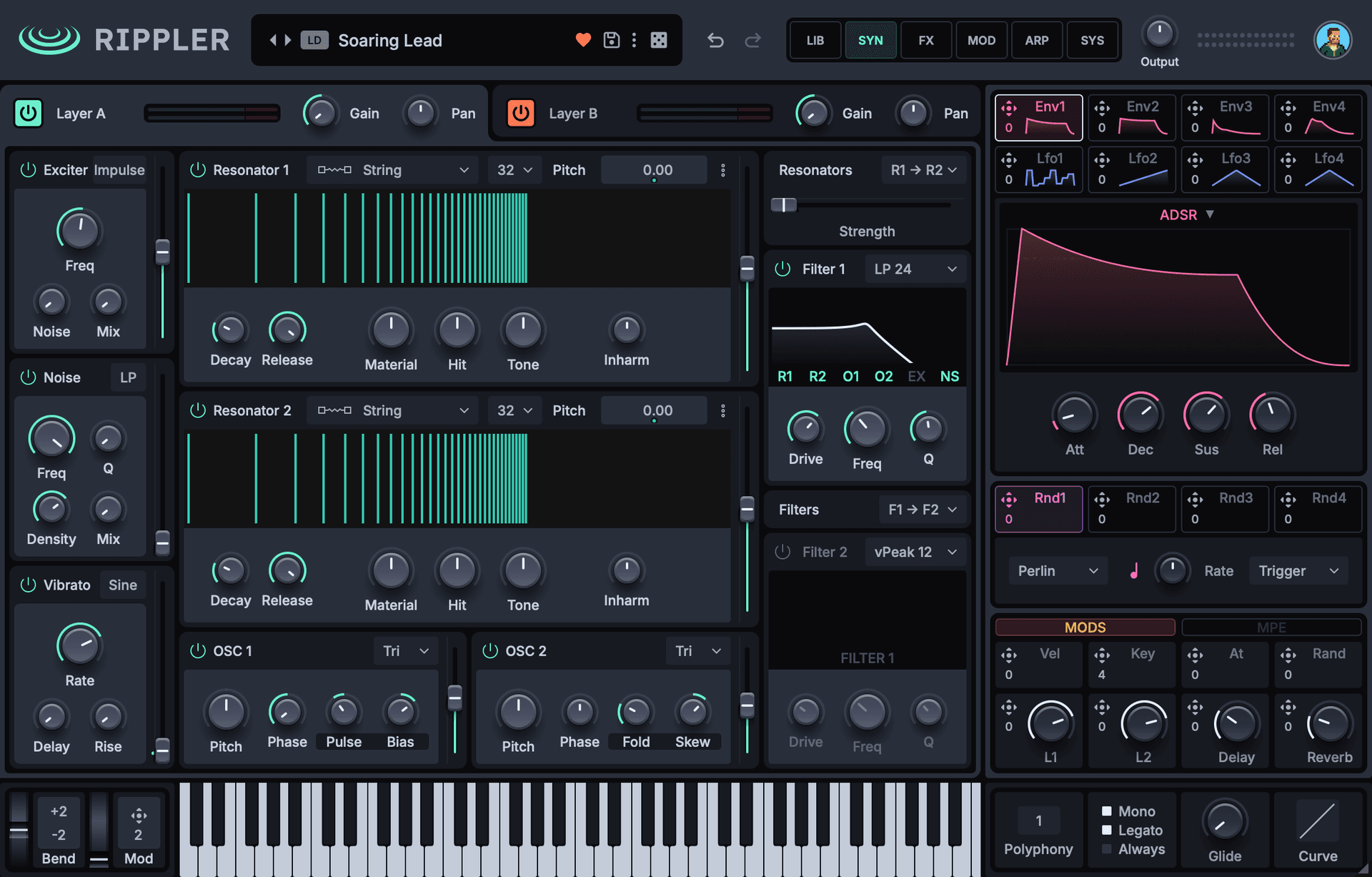
The technological core of reFX Rippler is the result of a sophisticated evolution. According to confirmed data, the project was born as the commercial and expanded version of a praised previous beta-stage development created by independent programmer Tiagolr, which has been refined, empowered, and endowed with a professional interface under the prestigious umbrella of reFX. The internal architecture of this synthesizer is divided into highly configurable modules that allow engineers to sculpt sound from its very acoustic genesis to its most extreme electronic manipulation.
- Two independent and advanced exciters, which include the possibility of importing custom audio samples (sample import) and fully adjustable noise generators.
- Two resonators equipped with multiple acoustic models, a fully customizable resonance editor, and extremely flexible routing options.
- Two additional oscillators that incorporate wavefolding technology to dramatically expand the harmonic content of the signal.
- Dual multimode filters that allow for sculpting frequencies with surgical precision and adapting to any mix.
- An integrated multi-effects processor, designed to polish, spatialize, and texturize the final signal before its output.
- A deep modulation system that houses four envelopes, four user-drawable LFOs, four randomizers, and eight quick-control macros.
- Absolute compatibility with expressive performance dynamics through velocity sensitivity and aftertouch.
The Acoustic Horizon in Contemporary Production
The foray of a brand of reFX's caliber into physical modeling represents a major strategic move for the music software industry. Historically, physical modeling synthesis has been considered a niche field due to the immense complexity of its mathematical algorithms, which are responsible for simulating the physical behavior of real materials like wood, metal, plastic, or glass when struck, rubbed, or blown. However, the masterful integration of these hyper-realistic acoustic models with conventional subtractive oscillators opens a huge door toward the creation of unprecedented hybrid textures.
For club music creators, ranging from the most cerebral and industrial techno to the deepest and most organic house, the ability to generate timbres that react naturally and chaotically to MIDI performance is an invaluable resource. Unlike wavetable synthesis or classic frequency modulation (FM), physical modeling grants a tactile, lively, and unpredictable quality to sound patches. Each pressed note can have slight harmonic variations, perfectly imitating the imperfection inherent in real instruments.
With Rippler, the company seems to have found the perfect balance between the abyssal depth of modular programming and the immediacy of use that has always characterized its successful product catalog. While waiting for the official final release date and details regarding its market price to be announced, the global community of producers and enthusiasts of virtual hardware and software is already preparing to integrate this new sonic beast into their digital audio workstations (DAW). What is undeniable is that the boundary between the purely synthetic and the acoustic is becoming increasingly blurred, and cutting-edge tools like this are positioned as the ideal vehicle to explore the sonic territories of tomorrow.